
Howard's "The Garden of Fear": Flowers of Evil and a Tower of Dread
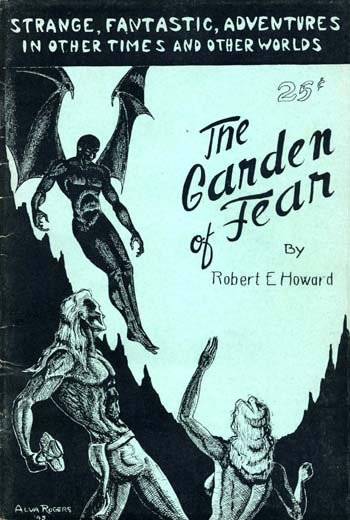
One of Robert E. Howard's greatest heroic fantasy series is the James Allison Cycle, in which a 20th century Texan--by a strange twist of fate--learns how to recall his past lives and adventures in prehistoric times.
"The Garden of Fear" is one of those stories. The concept of a previous incarnation in a mythological world, another of Howard's recurring themes—that each human being is a link in a chain of previous incarnations, along which, inevitably, a series of genetic traits have been repeated—is revisited here.
James Allison, who in a previous life was Hunwulf the Wanderer "in an age when emotions were expressed with a blow of a flint axe," is the protagonist. Published in Marvel Tales magazine, July-August 1934, its plot revolves around the confrontation between a young warrior, Hunwulf, and the winged being who has abducted his beloved.
It begins with Allison stating that, in the distant past, he "was Hunwulf, son of the golden-haired Aesir." He hails from a tribe of proto-Nordic people who left their homeland for an unknown destiny, marked by a ceaseless migration south and the brutal realities of primitive existence.
Hunwulf was born during this Völkerwanderung and never knew the arctic homeland of his people, reaching maturity on the journey. Coming of age, Hunwulf loved a woman named Gudrun, for which he was banished. Gudrun is offered to the most powerful hunter of the nomadic Aesir tribe to which they both belong: Heimdul. Hunwulf's intense love for Gudrun, a woman of incomparable beauty, drives the narrative.
As Howard writes:
“Year by year my [Hunwulf’s] tribe drifted southward, sometimes swinging in long arcs to east or west, sometimes lingering for months or years in fertile valleys or plains where the grass-eaters swarmed, but always forging slowly and inevitably southward. (...) And amidst this wandering, hunting and slaughtering, I came to full manhood and the love of Gudrun.
What shall I say of Gudrun? How describe color to the blind? I can say that her skin was whiter than milk, that her hair was living gold with the flame of the sun caught in it, that the supple beauty of her body would shame the dream that shaped the Grecian goddesses. (...)
For Gudrun I forsook my tribe and my people, and went into the wilderness, an exile and an outcast, with blood on my hands. (...)
[T]he dream of Gudrun was madness in my soul, a flame that burned eternally, and for her I slew Heimdul, crushing his skull with my flint-headed axe ere he could bear her to his horse-hide tent."
While the two lovers are spending time with a tribe of "slender, brown people", Gudrun is abducted by a winged creature. In search of his beloved, Hunwulf arrives at a lost valley guarded by antediluvian animals, where there is a doorless tower surrounded by a field of flowers that feed on human flesh.
This story is memorable for Howard's exploration of reincarnation, anthropology, theology, and evolution, and also for its exploration of the clash of races. Hunwulf belongs to a young, rising people, as evidenced by his physical appearance of a blond, robust Nordic. In contrast, the winged being, the last of a once powerful and world-dominating race, is tall, with jet-black skin and membranous bat-like wings. What was once commonplace in eons gone by now marks him as a monster. Perhaps some might think that his mockery of the young warrior points to a great inner evil that seems to correspond to his outward monstrosity.
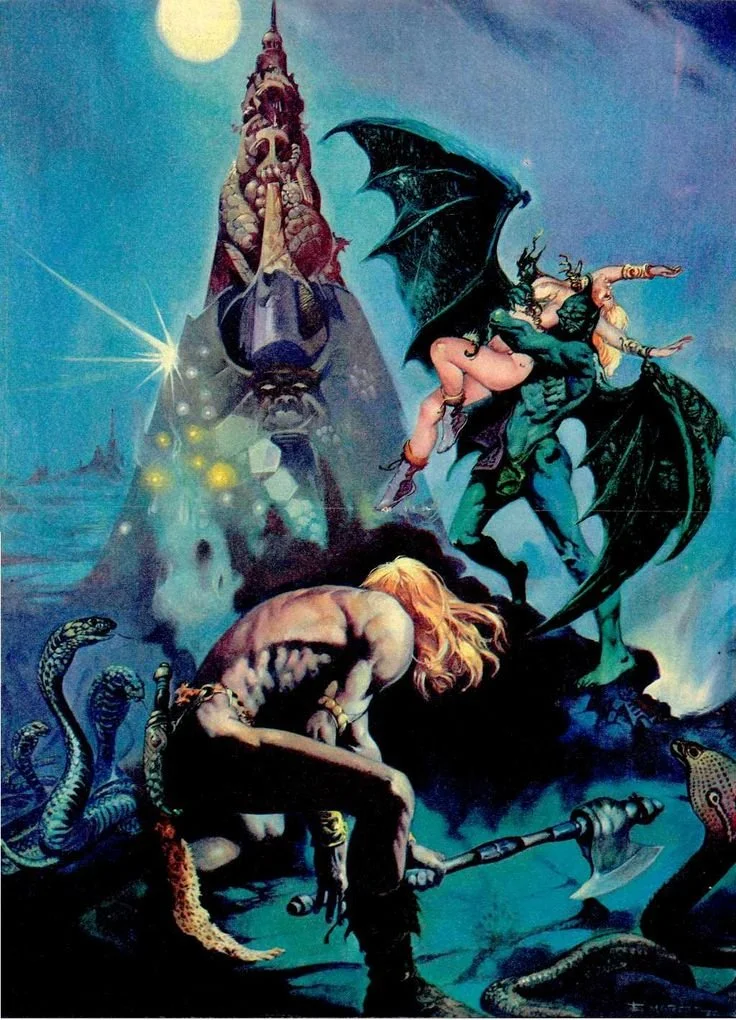
Esteban Maroto’s rendition of “The Garden of Fear”.
It should not be forgotten that all of this is narrated from Hunwulf/Allison's point of view. Hunwulf will ultimately defeat the Winged One not because he is more intelligent, but because this is also a story where Howard demonstrates the rise and fall of empires and civilizations. Cultural decline is a matter of a loss of both vitality and of will, something which young and rising peoples possess. Decadent peoples, despite whatever resistance they put forth, face a fatal decline.
We now encounter a curious phenomenon: the Winged Ones. They appear a couple of times in the stories of Conan's creator, in "The Garden of Fear" and "The Queen of the Black Coast." Howard's description of them, whether in "The Garden of Fear" or "The Queen of the Black Coast," is the same: human-like beings, considerably larger than average, very dark in color, with large wings, possessing a wisdom they have lost through degeneration and solitude. As James Allison says:
"I, James Allison, have pondered much on that phenomenon which I witnessed through the eyes of Hunwulf. Was that winged man merely a freak, an isolated example of distorted nature, dwelling in solitude and immemorial desolation? Or was he a survival of a forgotten race, which had risen, reigned and vanished before the coming of man as we know him? The little brown people of the hills might have told me, but we had no speech in common. Yet I am inclined to the latter theory. Winged men are not uncommon in mythology; they are met with in the folklore of many nations and many races. As far back as man may go in myth, chronicle and legend, he finds tales of harpies and winged gods, angels and demons. Legends are distorted shadows of pre-existent realities, I believe that once a race of winged black men ruled a pre-Adamite world, and that I, Hunwulf, met the last survivor of that race in the valley of the red blossoms."
It would be unlikely that a natural mutation could create beings with such astonishing characteristics, or we might also have to consider a cosmic origin, or a directed mutation; in any case, we would have no choice but to think of beings that came from Outside to live here or that were unknown creatures of terrestrial origin who manipulated earthly biology.
In this way, it is as if Howard were truly unearthing legends from our unknown prehistory, using atavism and ancestral survivals, all of it enshrouded by a preternatural aura. He constructs here, in a very subtle way, his own mythology, full of historical resonance and symbolism. REH addresses profound concepts in his James Allison Cycle, suggesting that we are learning the true history behind ancient legends and religions. It is a mythology which perhaps makes more sense and fits together better than what we've been told.
We also have here Howard's general idea of "ages undreamed of" which he always played with and of which the Hyborian Age is the best-known example. The result is a panorama of mysterious worlds and boundless adventure.
More on James Allison:
'The Valley of the Worm": Forging the Myth Behind the Myths
Howard's "Marchers of Valhalla": Battles, Cults, Love and Honor
Myth Manifesting in the Present: Robert E. Howard’s “Marchers of Valhalla”
The Ten Greatest Sword-and-Sorcery Stories by Robert E. Howard