
'The Valley of the Worm": Forging the Myth Behind the Myths
"The Valley of the Worm" is one of Robert E. Howard's most celebrated tales of heroic fantasy. Howard intended for his story to tell an archetypal legend—that of man versus monster—which has been repeated from generation to generation since the dawn of mankind.
As REH states in the first paragraph:
"You have heard the tale before in many guises wherein the hero was named Tyr, or Perseus, or Siegfried, or Beowulf, or Saint George. But it was Niord who met the loathly demoniac thing that crawled hideously up from hell, and from which meeting sprang the cycle of hero-tales that revolves down the ages until the very substance of the truth is lost and passes into the limbo of all forgotten legends. I know whereof I speak, for I was Niord."
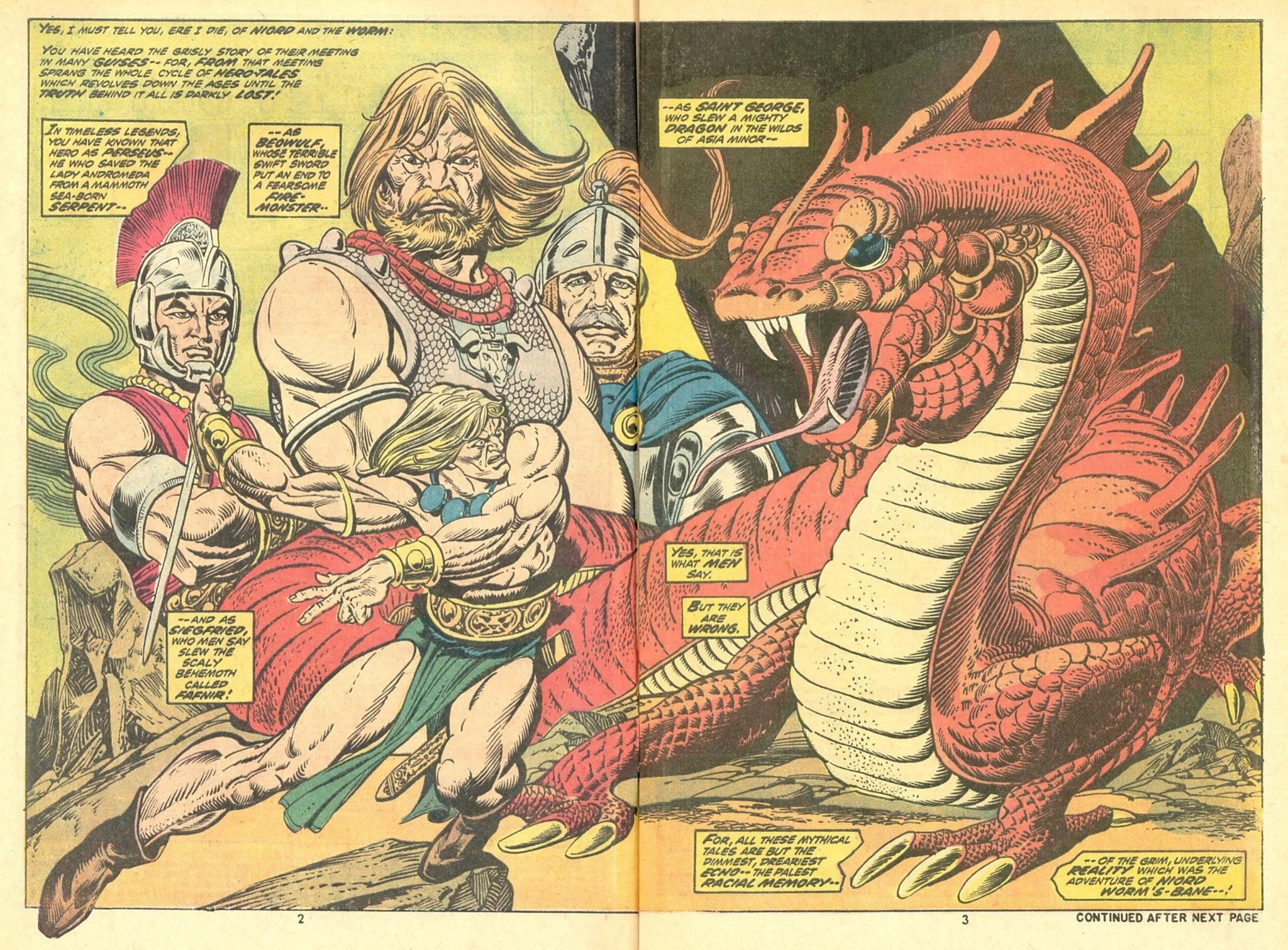
Art by Gil Kane.
The mythopoetic complexity displayed in that quote is a hallmark of the rigor with which Robert Howard fused history and mythology into his own fiction.
"The Valley of the Worm" is a work with epic connotations, Lovecraftian elements, and undoubtedly ranks among Robert Howard's best. From the very beginning of the tale, we are immediately drawn in through the words of its narrator and protagonist, James Allison, a crippled man nearing the end of his days. Allison possesses the ability to recall his past lives and who, on this occasion, recounts an entire odyssey in which he, Niord Worm's-Bane, defeats monstrous and demonic foes.
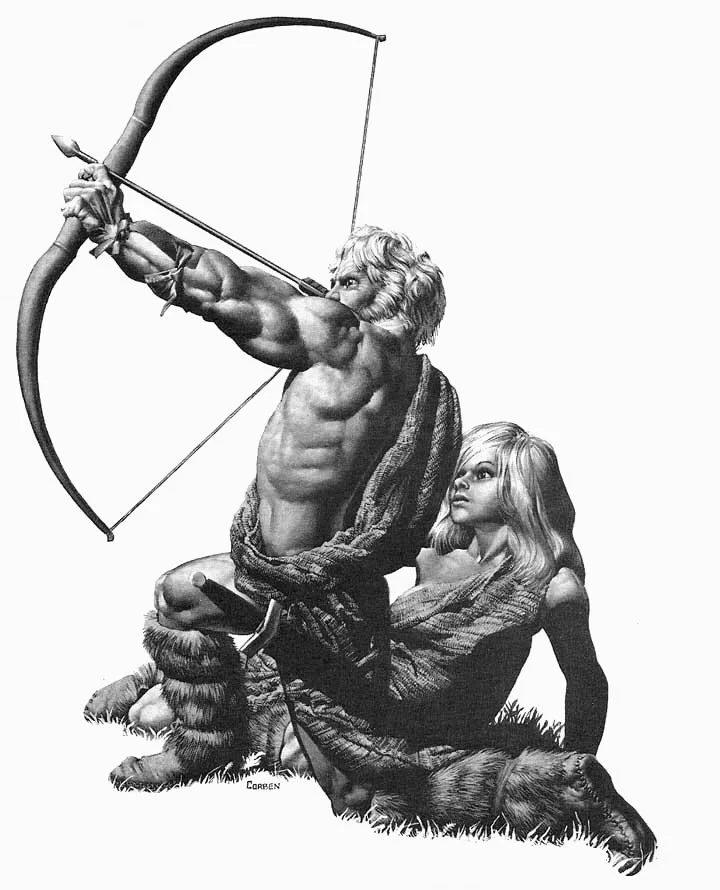
Art by Richard Corben.
Niord's saga harks back (much like the tale of Hialmar in "Marchers of Valhalla") to a bygone era, to a time when he belonged to a tribe of the Aesir, driven south by encroaching glaciers. His tribe clashed with the Picts (a people Howard once again uses in his fiction, though this time they have been somewhat degraded by their jungled environment), until Niord's respect for one of the Pictish warriors manages to establish a kind of friendly communication between the two peoples. Then, a group of young Aesir warriors and their companions set out to form their own tribe in the abandoned Valley of the Worm, despite the warnings of their Pictish neighbors.
What follows could be considered the original version of the legends Allison mentions. An ancient and terrifying creature has awakened, and in a few days it devastates the settlement and exterminates almost all of its inhabitants.
Now, true horror arrives in the form of the creature that gives the story its title; a monstrous being that bears a striking resemblance to those in the Cthulhu Mythos, which myth-cycle Robert E. Howard helped to shape. Here, we first encounter a new Lovecraftian abomination: a monstrous, worm-like being, as large as a mountain and made of a substance that is not flesh, summoned by an anthropoid entity that plays a strange flute. Howard's emphasis on the worm-like appearance makes me think it could be one of the sinister beings that make up Lovecraft's literary horde of subterranean creatures.
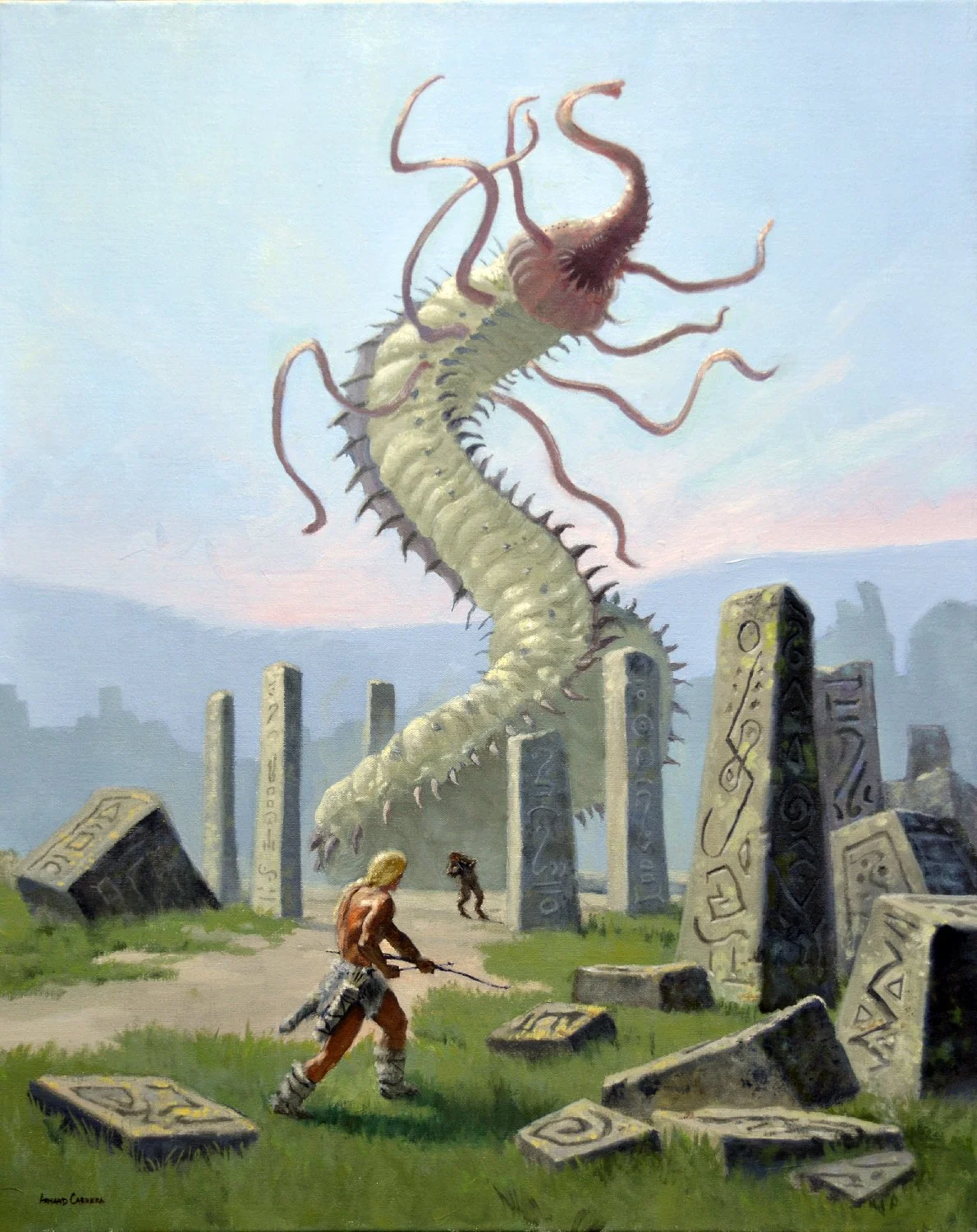
Art by Cabrera.
Secondly, we have the piper: in appearance, he is reminiscent of the Gnophkehs that assaulted Olathoe in the land of Lomar. The mention of a soul-twisting flute recalls the mad pipers who play and dance around Azathoth, the Blind Idiot-God, enthroned in Chaos at the center of the universe.
The environment surrounding the Worm, with crumbling ruins strewn about and the presence of an abhuman lackey who performs an arcane ritual to summon his master, makes this story quite unsettling. Added to this is the gore; "The Valley of the Worm" contains at least two massacres and another battle between the hero and a monstrous beast, which combat turns out to be quite bloody.
"The Valley of the Worm" is an homage to the Nordic dragon-slaying epics, especially Beowulf, but also to the Sigurd/Siegfried sagas, as REH states in his first paragraph. In fact, the connection between myths (the so-called "comparative mythology") interwoven by him, once again reveals the breadth of learning that Robert E. Howard possessed.
Howard forged his own myth based on Nordic legends through the singular combat between Niord and the Worm. In his 'James Allison Cycle', REH created the myths behind the myths, but his vision was even darker and more savage than the originals.