
Howard's "Marchers of Valhalla": Battles, Cults, Love and Honor
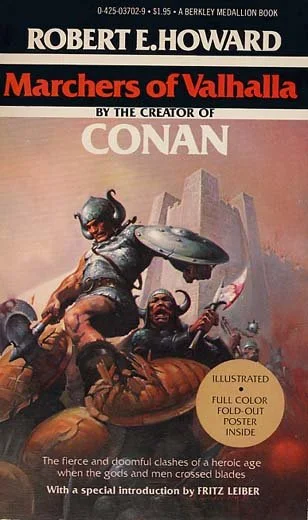
Cover by Ken Kelly.
James Allison, a character through whom Howard explored the concepts of racial memory and reincarnation, is a man who has lived many lives and is able to recall his past identities, always as a hero facing great dangers.
Here we have Howard's general idea of "unknown prehistories," with which he always played, and of which the Hyborian Age is the best-known example. The result is a collection of worlds of endless mystery and adventure. Howard even conceived a cycle based around James Allison, who had been crippled as a teen and therefore feels profound physical and existential pain. In Howard's tales, James reminisces about his past incarnations, in all of which, and in contrast to his current state of powerlessness, he was an indomitable warrior.
During his lifetime, Howard published two magnificent stories featuring the character (leaving, as with all his other cycles, several others unpublished, some remaining only as fragments), in which Allison's ancestor is a proto-Norse warrior living in an inconceivably distant era who experiences various adventures during his people's southward migrations. Contact with other civilizations, both more primitive and decadent, makes these stories an excellent entry point for studying how Robert Howard applied the concept of "barbarism vs. civilization" to his fiction.
James Allison is a character who, like Robert Howard, seeks escape from his dismal reality through dreams and imagination. “Marchers of Valhalla”, which also explores the theme of Völkerwanderung (the wandering of peoples), is inspired by Jack London's novel The Star Rover, one of Howard's favorites. As he himself said: "I have read it and reread it over and over again, over the years, and it goes to my head, like wine."
Howard was an avid reader of history, and his passion was historical fiction. He wrote in a 1933 letter to H. P. Lovecraft:
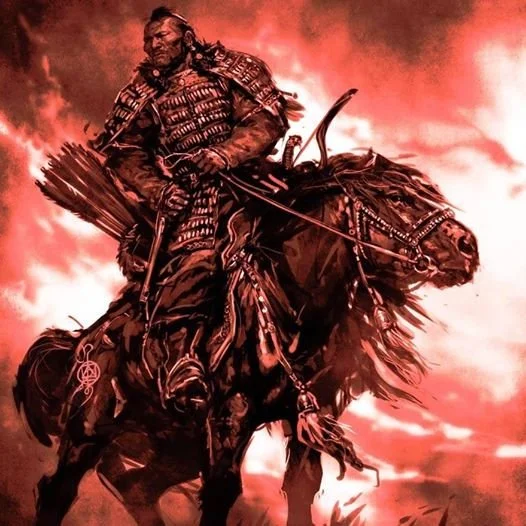
Art by Ganbat Badamkhand.
“For me, there is no literary work half as exciting as rewriting history under the guise of fiction… A single paragraph can be saturated with enough action and drama to fill a whole volume of fiction.”
Howard’s interest in history, however great, did not extend to “civilized” peoples:
“When a race—almost any race—is emerging from barbarism, or has not yet emerged, it arouses my interest. I have the impression that I understand it and can write profoundly about it. But, as it progresses toward civilization, it begins to elude me, until at last it vanishes completely, and I find its customs, ways of thinking, and ambitions utterly alien and baffling. Thus, the early Mongol conquerors of China inspire in me the greatest interest and the highest esteem; But a few generations later, when they have adopted the civilization of their subjects, they inspire no interest in me whatsoever. My study of history has been a constant search for new barbarians, from age to age.”
It is evident that the concept of civilization that Howard uses as the essential dramatic basis of his warrior cycle owes much to the Darwinian theories in vogue at the time: it is known, for example, that he read with delight Oswald Spengler’s then very famous work, The Decline of the West. Thus, the Texan writer identified with the cyclical concept defended by this German author: once past its zenith, each people inevitably begins a decline that will lead to its disappearance. This disappearance can be accelerated by competition with and invasion from another people that begins the downward path, or (without external influence) it can fall into a slow languishing, which results in a decadence that Howard always associated (he even expresses it in his letters) with hedonistic addictions and sexual perversion.
What makes Howard's literature immortal, above and beyond the ideological substrate upon which his dramaturgy rests, is the timeless transcendence he achieves through his fusion of twilight epic and rugged lyricism. Rising cultures clash with tottering empires in thunderous conflict, all of it being conveyed to the reader in a manner both poetic and savage.
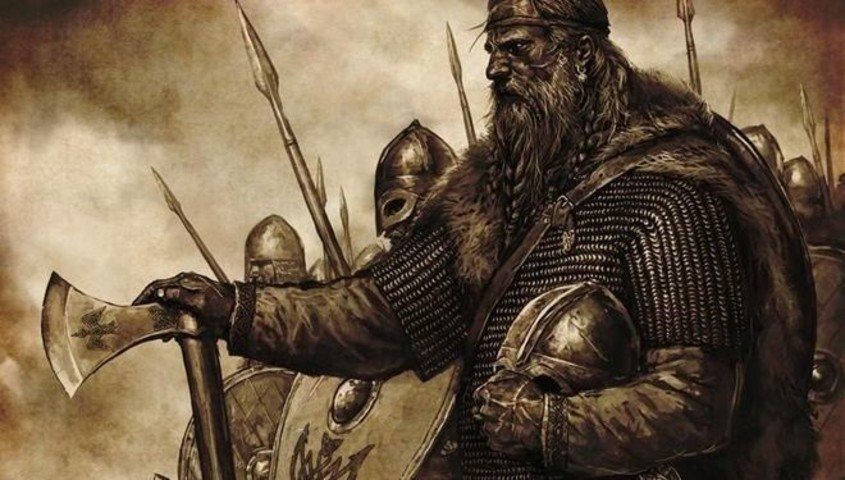
Art by Ganbat Badamkhand.
"Marchers of Valhalla" introduces the central concept of the Allison stories with the arrival of a woman who appears to James in Texas as he gazes bitterly at a valley. She addresses Allison as Hialmar, waves her hands before his eyes, and evokes a memory of one of his past lives: Hialmar, an Aesir warrior who marched with his people on their Völkerwanderung, a predatory migration.
Hialmar's war-band is composed of Aesir fighting men who, having traversed ancient Proto-Asia, then crossed into the then (almost) uninhabited Americas. Eventually, they arrive at a city called Khemu, and the people, needing the Aesir and their weapons, hire them to fight their enemies. A large fleet from the sea is attacking Khemu, and in exchange for protection, the inhabitants of Khemu will provide treasures, food, and women. The Aesir accept the deal, and thus, the stage is set for a brilliant tale of war, intrigue, and betrayal.
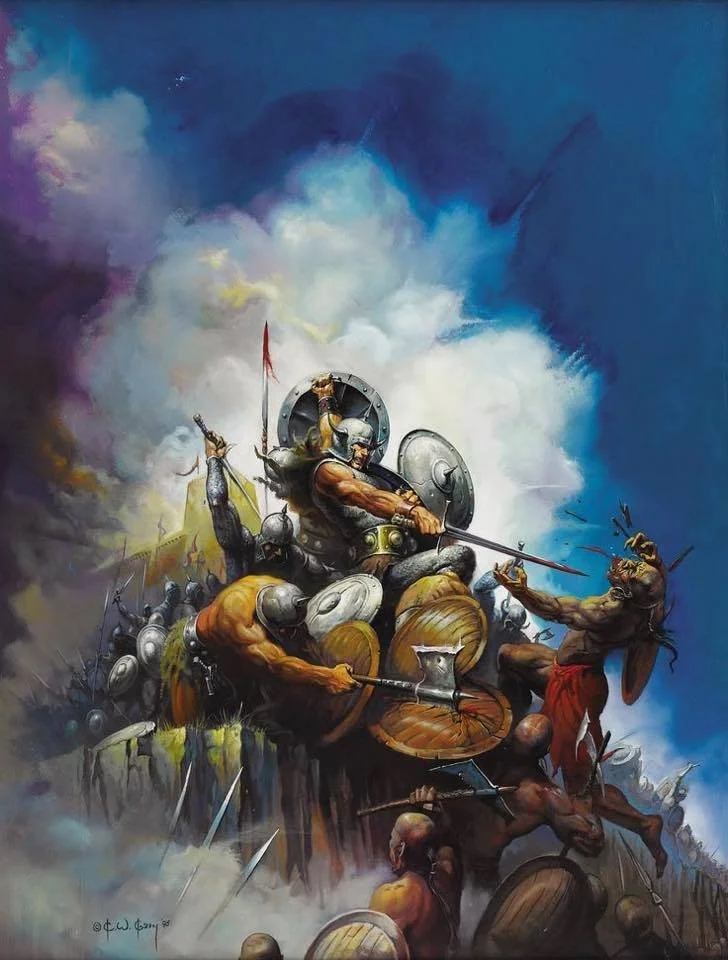
Ken Kelly’s 1990s depiction of “Marchers of Valhalla”.
"Marchers of Valhalla" is the longest, and possibly the best, of the James Allison tales. It is a tremendous and exciting story which would make a great film in the hands of a competent director. It deserves to be brought to the screen, as it possesses an almost cinematic visual power.
The violence of the battles, the blows and the wounds, are truly impressive. These are scenes of carnage that only Robert Howard could narrate... Blood spatters, hearts are pierced by swords, skulls crushed under the weight of axes, etc. Towards the end of the story, a supernatural or fantastical element makes its presence felt in a spectacular way (until the end, it was a tale of war, conquest, and love, with a touch of intrigue).
"Marchers of Valhalla" is a thrilling story where one can enjoy the exquisite and ferocious way in which REH narrates Hialmar's adventures, adventures full of bloody battles, ancient cults, love, and honor. A true marvel of heroic fantasy.
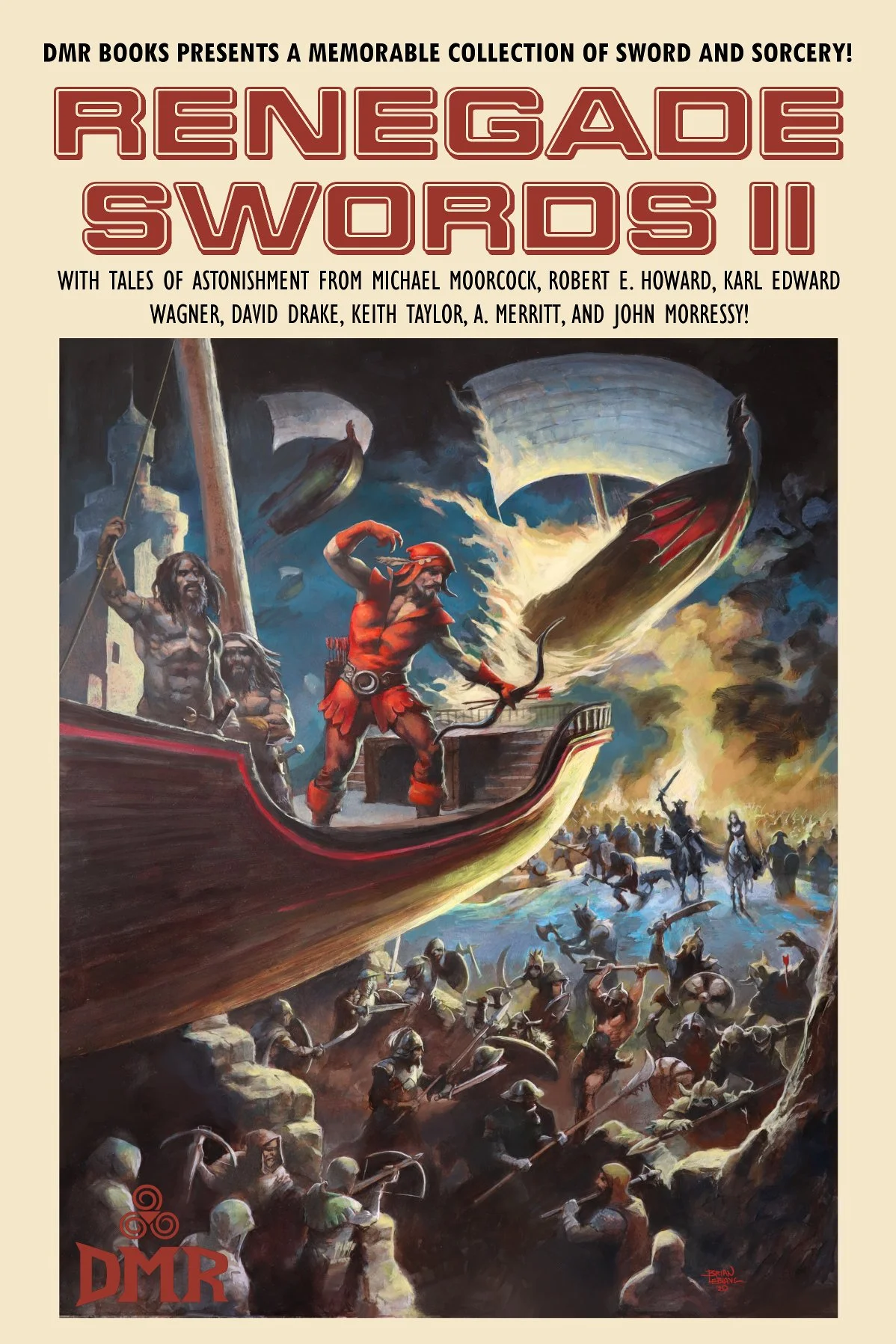
DMR Books reprinted “Marchers of Valhalla” in Renegade Swords II, alongside stories by Michael Moorcock, Karl Edward Wagner, Keith Taylor, and more great fantasy authors. More information on it can be found here.