
Kelkor -- Gigachad of Lemuria
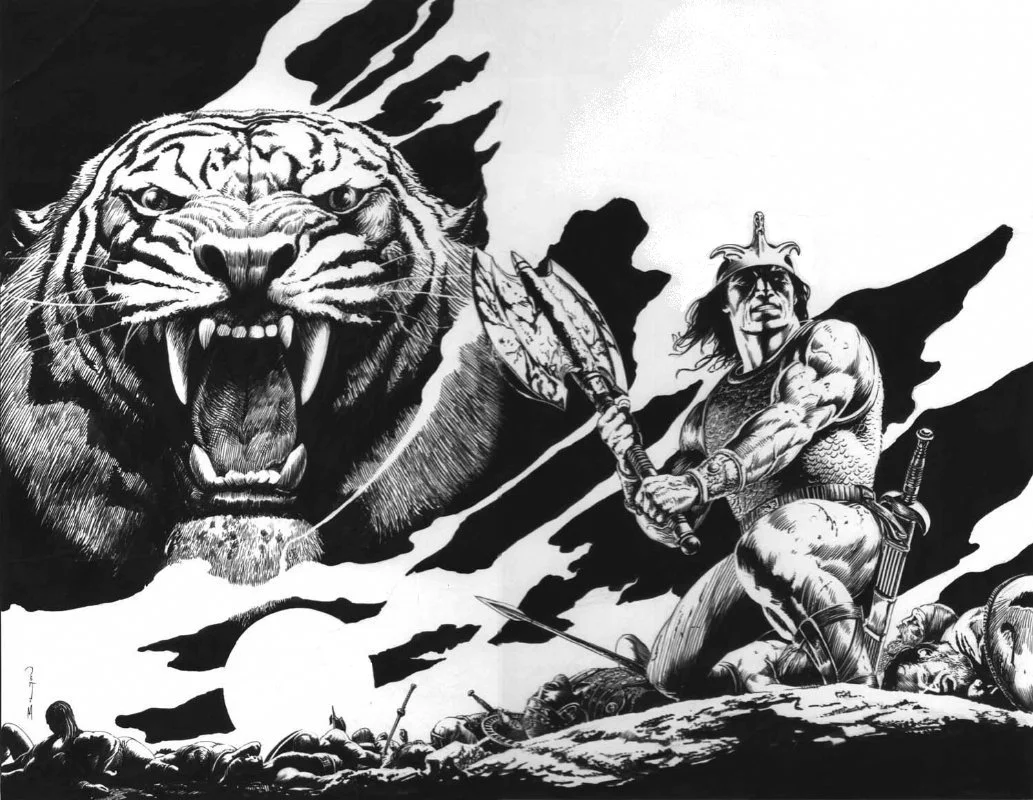
Kull, as depicted by John Bolton.
It would be difficult to argue against someone stating that Kull the Atlantean—also Emperor of the Valusian Empire—was one of the deadliest men of his time. It could also be said that Kull was one of the more widely-traveled personages of his tumultuous age. According to various Howardian sources, Kull had ranged as far west as the Lemurian Isles, as far south as the ‘southern jungles’ and had done his share of wandering around the Seven Empires before he bestrode the Topaz Throne.
With that in mind, I started to write Part Two of my DMR Books Blog series, “Thurian Age Maps and Me”, but then I realized many of its conclusions hinged upon the credibility of just one man: Kelkor the Lemurian.
Kelkor's history is complicated. He is crucial in two Kull tales, but his role and status in those two is somewhat different, as is the spelling of his name. I am going to somewhat invert Kelkor's--conjectured--literary timeline for several reasons. One is for purposes of canonicity and another relates to Thurian Age cartography.
Kelkor's--called 'Kelka' here--first appearance in a completed Kull yarn was in the iconic "By This Axe I Rule!". In the very first chapter, Ascalante speaks to his scarred slave, explaining why Gromel--commander of the Black Legion--threw in his lot for the coup d’état against Kull:
"Gromel hates Kelka, commander of the Red Slayers, and thinks he [Gromel] should have that position."
Here we see a certain 'Kelka' as the commander of the Red Slayers, the Valusian version of the Praetorian Guard. Within the actual Valusian military--which Brule and his Pictish auxiliaries exist outside of--'Kelka' is near the top, if not the highest, of Valusian military commanders.
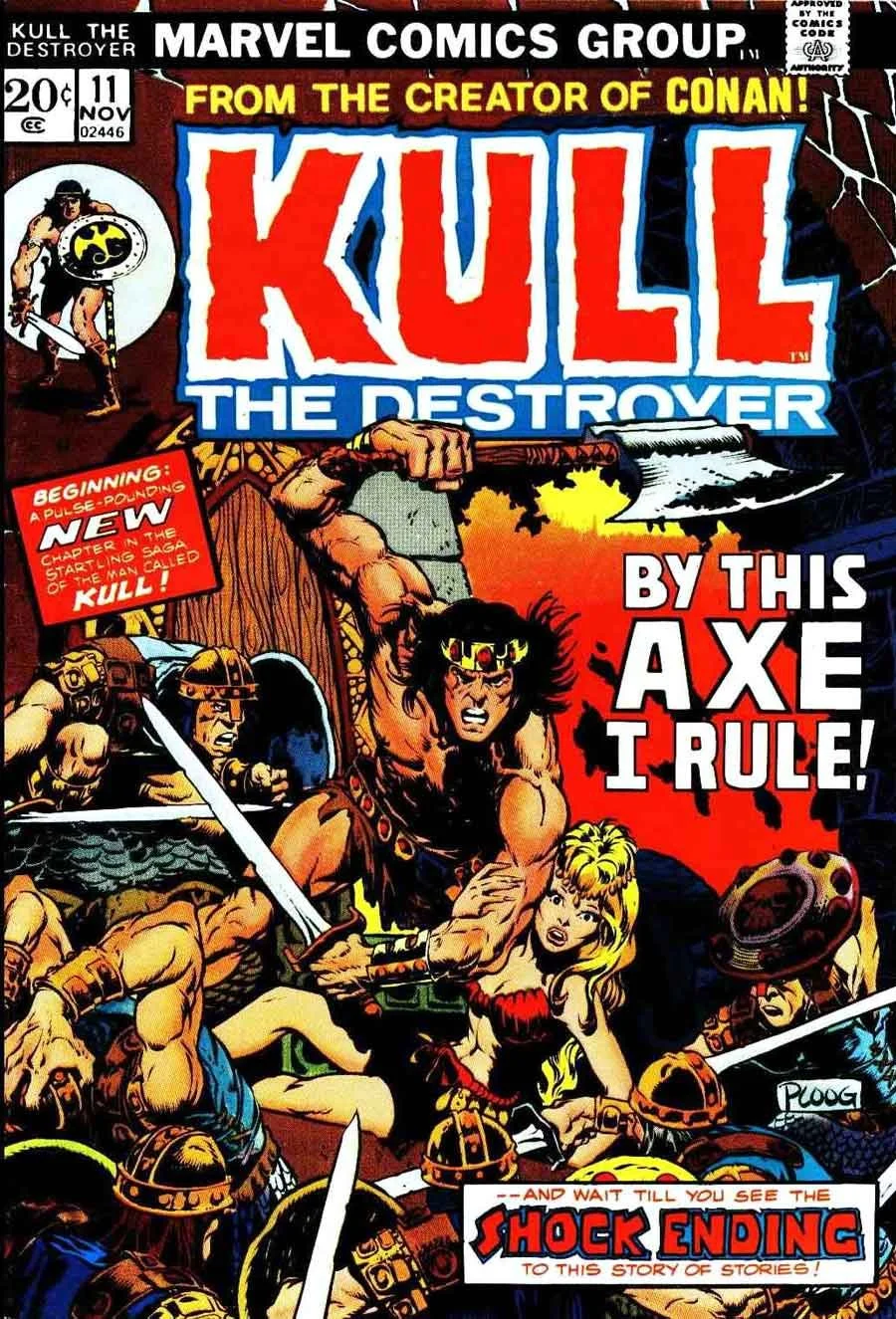
Art by Mike Ploog.
Next up is "Swords of the Purple Kingdom". As in 'Axe', the plot revolves around a coup d’état. Upon discovering a possible security breach, Ka-Nu/Kananu orders Brule and 'Kelka' to check Kull's chambers. Once he learns that Kull is nowhere to be found, Kananu screams, “Comb the city! Guard all the gates! Kelka, rouse out the full force of the Red Slayers!"
Once again, Kelka appears to be the commander of the Red Slayers and also one of the top men in the Valusian court that Kananu/Ka-nu actually trusts.
Here is what Patrice Louinet says in "Atlantean Genesis" about those two Kull yarns:
'By This Axe I Rule!' and 'Swords of the Purple Kingdom' were completed in rapid succession, probably in May and June 1929. In many ways, both stories mark a return to the roots of the Kull series. In 'Exile of Atlantis' there were mentioned the characters of Ascalante and Ala; these are also the names of characters, albeit different ones, in the 1929 story. More important, the plots of the 1929 tales revolve around an attempted coup d’état, as did 'The Shadow Kingdom'.
In my opinion, it's impossible to come away with any other conclusion--just from the implications of the texts--than Kelka was a military bad-ass and a man to be trusted by both Kull and Ka-nu/Kananu.
So, let's back-track to early 1928. Here is what Patrice Louinet had to say in "Atlantean Genesis":
"It was some weeks before Howard would return to writing Kull stories [after writing The Mirrors of Tuzun Thune]. In the first months of 1928, he began what could have been a serial-length Kull story, but abandoned it at the eighteenth page. Howard probably realized that his story was rambling and unconvincing, relegated it to his archives, and immediately began work on another Kull story, which was to be titled 'Delcardes’ Cat'."
What Louinet is referring to is a lengthy fragment named by some modern Robert E. Howard scholars as "The Stagus Fragment". It can be found in Kull: Exile of Atlantis between "The Mirrors of Tuzun Thune" and "The Cat and the Skull".
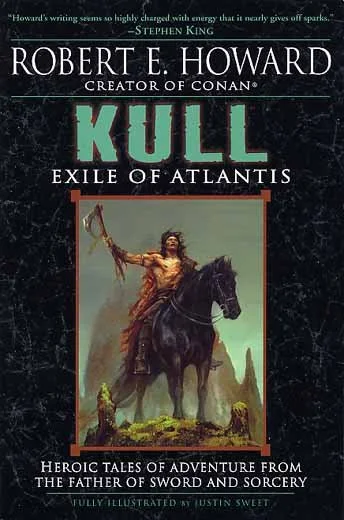
To summarize briefly, the plot involves Kull being gravely insulted by Felgar of Farsun and then Kull rounding up a posse to chase down the cowardly scalawag, which scoundrel flees eastward, just a step ahead of his pursuers.
Kull has Brule call up a force of Pictish cavalry. He also summons the best of the Red Slayers, commanded by Kelkor. Yep, 'Kelkor'.
Louinet says this yarn was written before the two mentioned above. After some serious consideration, I must agree. I'll discuss why after quoting the pertinent passages.
Here we see Kull bringing together his expeditionary force:
'At the front of this fierce array sat Brule, chieftain of Valusia’s most formidable allies, and Kelkor, second commander of the Red Slayers. (...)
“We ride into the sunrise,” remarked Kelkor.
“Aye,” was Brule’s grim response. “And some of us ride beyond the sunrise.”
Kelkor shrugged his shoulders. “So be it. That is the destiny of a warrior.” '
Kelkor/Kelka's very first verbal debut. Totally bad-ass. What stands out here is that Kelkor is 'second commander' of the Slayers. That definitely contradicts "By This Act I Rule!" and also Kelka's implied rank in "Swords of the Purple Kingdom". That said, I find any suggestion that we're looking at two different characters to be utterly ludicrous.
A bit later, we find Kull and his bros riding across the Camoonian Desert, the south-easternmost spur of the Valusian Empire. Everybody—including Kull—is totally exhausted...except Kelkor:
"Kull glanced at the commander [Kelkor]. Straight as a spear sat Kelkor in his saddle, inflexible, unbending as a statue of steel. The commander had always reminded the king of a fine sword of polished steel. A man of terrific power, and mighty forces, the most powerful thing about him was his absolute control of himself. An icy calmness had always characterized his words and deeds. In the heat and vituperation of council, in the wild wrack of battle, Kelkor was always cool, never confused.
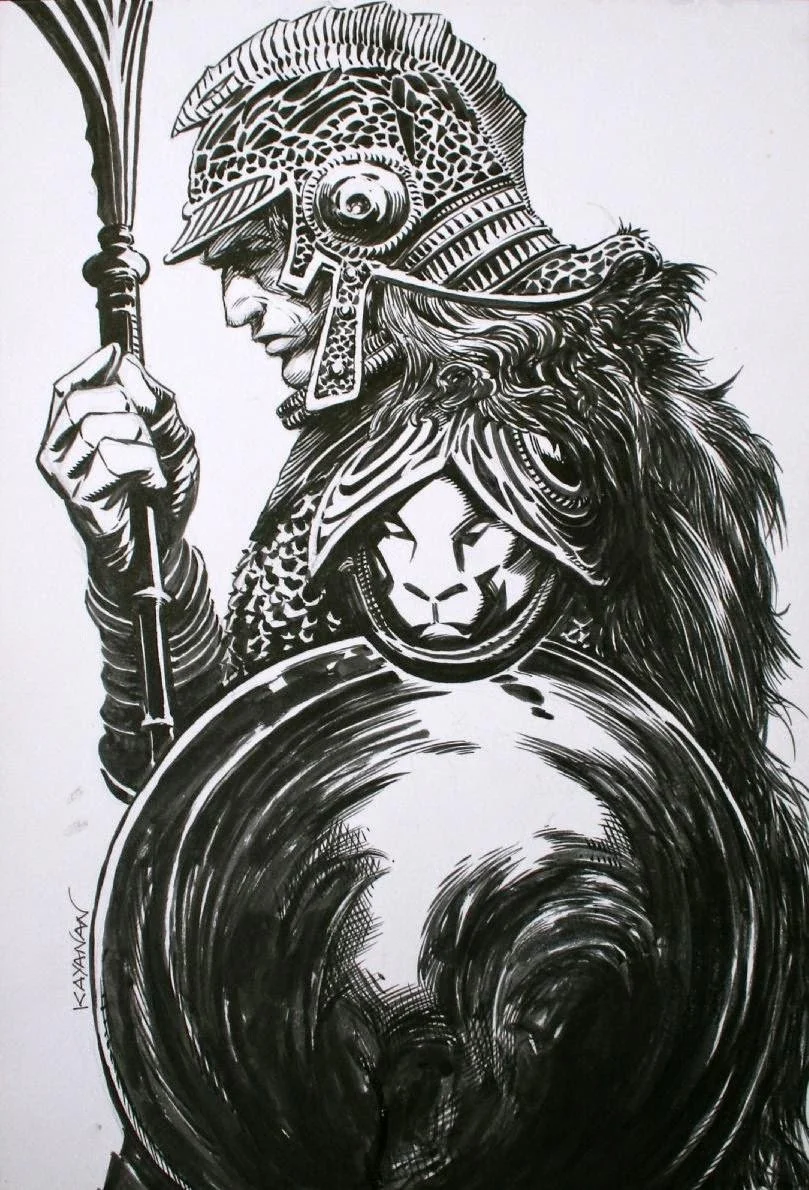
Art by Rafael Kayanan.
He had few friends, nor did he strive to make friends. His qualities alone had raised him from an unknown warrior in the ranks of the mercenaries, to the second highest rank in Valusian armies–and only the fact of his birth debarred him from the highest. For custom decreed that the lord commander of troops must be a Valusian and Kelkor was a Lemurian. Yet he looked more a Valusian than a Lemurian as he sat his horse, for he was built differently from most of his race, being tall and leanly but strongly built. His strange eyes alone betrayed his race.
But Kelkor sat upright and unmoved, under the weight of full armor, seemingly untouched by the heat and discomfort that harried the rest."
So, here we see Kelkor as being tougher than even Kull or Brule. Also, we get a hint about the Lemurian phenotype. As REH says:
"Yet he looked more a Valusian than a Lemurian as he sat his horse, for he was built differently from most of his race, being tall and leanly but strongly built. His strange eyes alone betrayed his race."
The implication is that Valusians/ethnic Thurians were typically "tall and leanly but strongly built". Lemurians, by implication, were not. REH's "Men of the Shadows" certainly indicates that. The other Howardian Lemurian who Kelkor does sound like, phenotypically, is Ishtar in "Marchers of Valhalla", who was a royal Lemurian...most likely with a lot of Muvian blood in her veins. She also had 'strange eyes', which seems to be Howard's way to describe eyes with epicanthic folds.
Now is as good a place as any to note that--according to REH--the Lemurian Isles (also referred to as 'Lemuria') were situated in the Central Pacific. East of them were the Pictish Isles. Far to the east of the Pictish Isles was Atlantis. Across a fairly narrow strait from Atlantis was Valusia and the rest of the Thurian continent.
The Lemurians were the mortal enemies of the Picts and the Atlanteans. The Valusians? Not so much. As we see in "The Shadow Kingdom", the 'bowmen of Lemuria' were mercenaries in the service of Valusia when Kull took power. For Kull and Brule to give a Lemurian a measure of respect--let alone admire him--demonstrates just how competent and deadly Kelka/Kelkor was.
So, Kull's cavalcade crosses over the western border into the kingdom of Zarfhaana. They're trying to figure out which direction the scoundrel--Felgar of Farsun--might run. Kelkor provides a logical argument:
“Here is our position,” said he [Kelkor], scrawling a map in the ashes of the camp-fire with his scabbard end. “North, Felgar is not likely to go–assuming as we do that he does not intend remaining in Zarfhaana–because beyond Zarfhaana is the sea, swarming with pirates and sea-rovers. South he will not go because there lies Thurania, foe of his nation. Now it is my guess that he will strike straight east as he was travelling, cross Zarfhaana’s eastern border somewhere near the frontier city of Talunia, and go into the wastelands of Grondar; thence I believe he will turn south seeking to gain Farsun–which lies west of Valusia–through the small principalities south of Thurania.”
“Here is much supposition, Kelkor,” said Kull. “If Felgar wishes to win through to Farsun, why in Valka’s name did he strike in the exactly opposite direction?”
“Because, as you know Kull, in these unsettled times all our borders except the eastern-most are closely guarded. He could never have gotten through without proper explanation, much less have carried the countess with him.”
“I believe Kelkor is right, Kull,” said Brule, eyes dancing with impatience to be in the saddle. “His arguments sound logical, at any rate.”
“As good a plan as any,” replied Kull. “We ride east.”
This is an incredibly revealing exchange. Kull and Brule both basically take Kelkor's word for it. Only Kull even tries to contradict him. That suggests that neither of them had as much experience and/or cartographic knowledge of the lands east, north-east and south of Valusia as Kelkor did. Judging from clues in the Kull texts, Brule had likely already journeyed east of Valusia with Ka-nu/Kananu. Kull is a whole 'nother story.
We also have indications of general unrest along all of Valusia's borders other than Zarfhaana. That is a fact that might come in handy for a Kull chronology.
I think Louinet's literary chronology is right in this case. It appears that REH originally saw Kelkor as 'second-in-command' of the Red Slayers in 'The Stagus Fragment', but then something happened before the events of 'Axe'.
Obviously, Kelkor proved himself to such a heroic extent that when the 'Stagus' incident resolved itself, Kull went in and changed the Valusian 'custom' which precluded Kelkor from commanding the Red Slayers, presaging a similar move he later made in 'By This Axe I Rule!'. In fact, it could be argued that such a move--which enraged Gromel--helped make Ascalante's plot a reality.
So, I think I've established Kelkor's importance, competence and trustworthiness sufficiently. Now, I need to explain why I keep calling him 'Kelkor'.
I would hope some of you have read my essay, 'Robert E. Howard: Tiers of Canonicity'. I still stand by it. That said, the Kelkor/Kelka thing presents a serious test to my rules/paradigm, which paradigm I think is pretty solid and workable.
Here are the facts: REH called the Lemurian in question 'Kelkor' first in a yarn which was never finished. Then, Howard called the same person 'Kelka' in two completed stories which he submitted for publication--neither of which were published in Bob's lifetime. By my own rules, barely, the Lemurian should be named 'Kelka'.
However, we also have another major Howard yarn which was also submitted for publication: 'Marchers of Valhalla'. In it, the protagonist's best friend is a post-Hyborian Age Pict named 'Kelka'. For those who don't know any better, the Picts and Lemurians are wildly different ethnic groups. Here, we have a Lemurian and a Pict with the exact same name. Howard was notable for keeping such things straight, but he dropped the ball somewhat here.
'Marchers' is note-worthy for containing two primary characters with the same names as primary characters in other REH yarns. In this case, the original name of the MoV protagonist was 'Niord'. REH carried it over to 'The Valley of the Worm', which was published by Weird Tales, unlike 'Marchers'. When the opportunity arose to finally publish 'Marchers of Valhalla', Glenn Lord--in order to keep things straight--plucked a (perfectly good) name from TVotW for the 'Marchers' protagonist, since 'Worm' had a far longer publishing pedigree.
Pretty reasonable, in my opinion. Keeping reader confusion to a minimum is a good thing. I could also bring up the fact that most Conan fans refer to King 'Numedides' rather than 'Namedides', even though REH used ‘Namedides’ in later Conan yarns.
My main argument would be this: 'Marchers' Kelka is a major character in that yarn. His name also echoes that of a known Pictish deity: Golka. Meanwhile, Kull's 'Kelka' is almost a total cipher and basically off-stage—he is never described, nor does he speak. As 'Kelkor', the Lemurian is a major character, if not nearly the dominant one--in the story fragment we have. You could almost call it 'The Kelkor Fragment'. In addition, his name resembles, linguistically, another high-status Lemurian: Ishtar.
So, in my opinion, calling the Lemurian gigachad 'Kelkor' rather than 'Kelka' bends my rules but doesn't quite break them. I would hope any future gaming/comics pasticheurs would use that name--considering that Kelkor/Kelka has been almost completely ignored despite being a major figure in Kull's court. ‘Kelkor’ and ‘Kelka (the Pict)’ both deserve their share of glory without confusion. Then again, I would be fine with him getting half the recognition he obviously deserves under either name.
If you've enjoyed this essay, hang in there. I intend on exploring Kelkor the Lemurian further in a future post. However, I also have Thurian Age cartography to attend to.