
Burroughs' Moon Trilogy -- Under the Kalkar Flag

As I noted in my previous post, Edgar Rice Burroughs started out his ‘Moon Trilogy’ with a desire to write a post-apocalyptic tale set in 2125, wherein Soviet Bolsheviks had conquered the world. The proposed title was “Under the Red Flag”. This was in 1919, when most Western intellectuals saw the (then) recent Bolshevik Revolution in Russia as humanity’s last, best hope.
ERB was no debutante when it came to post-apocalyptic fiction. He had already written Beyond Thirty—later retitled as The Lost Continent—in 1915, which envisioned the Earth two hundred years after a World War I timeline wherein the USA stayed out and let the Old World destroy itself. That novel deserves its own review.
As stated elsewhere, Ed's editors stiff-armed his proposal and demanded something like The Princess of Mars. We're talking ERB in his prime. He had imagination to burn. He gave them what they wanted with The Moon Maid—a rousing sword & planet novel—and then tied that back into his original plan. The result was The Moon Men, published in early 1925.
SPOILER WARNING: This story is over 100 years old and is widely available in various formats.
The Moon Maid's hero is Julian the 5th. He also appears at the beginning of The Moon Men. Earth has been invaded by the collectivist Kalkars—humanoids from the Moon—led by a genius scientist from Earth, Orthis. Julian dies bringing down the vile Orthis in a massive aerial battle, depriving the brutish and filthy Kalkars of their leader and technological advantages. However, the damage is done and the Kalkars end up ruling most of the Earth, including the USA. Julian leaves behind his widow, Nah-ee-lah, and their son, Julian the 6th, who survive as best they can.
Flash forward to the year 2120.
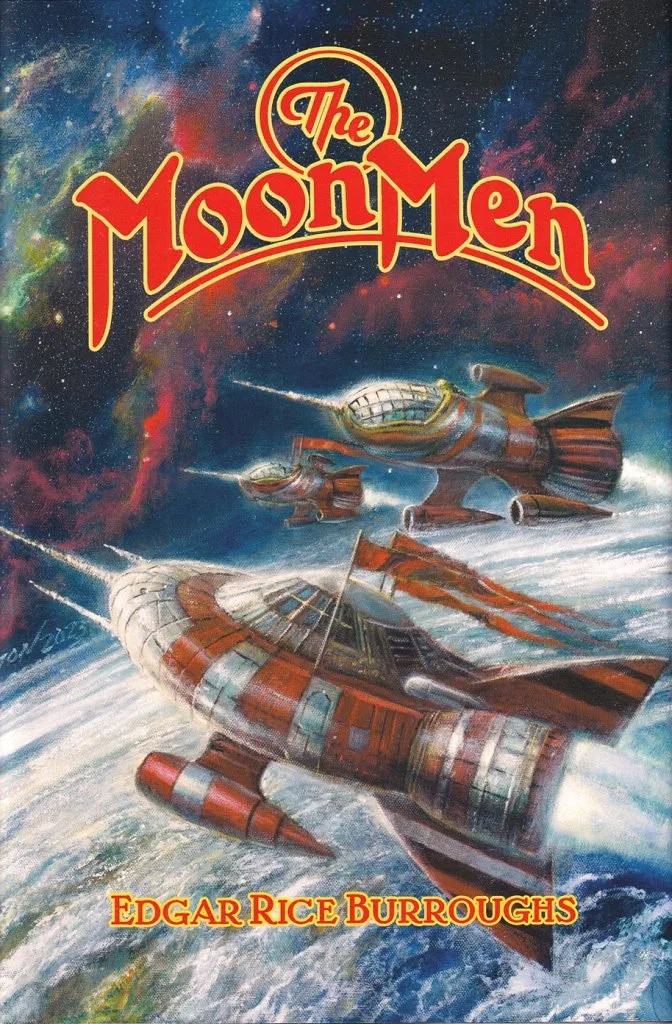
The Kalkars descend upon Earth. Art by Bob Eggleton.
Julian the 8th is scraping by in the 'Teivos' --a vague Kalkar administrative unit--of Chicago.* Kalkars, half-breeds and collaborators roam the streets with impunity. Virtually nobody can be trusted.
As Julian the 9th states:
'I recall one poor devil from Milwaukee who staggered into our market place of a Saturday. He was nothing more than a bag of bones and he told us that fully ten thousand people had died of starvation the preceding month in his Teivos.'
Edgar Rice Burroughs wrote those words at least eight years before the horrors of Stalin's Holodomor in Ukraine became a reality. And, yet, there are plenty of 'academics' who would consign ERB to the trash-heap of literary relevance. It should also be noted that the famine in Milwaukee wasn’t part of the ‘birthing pangs’ of the Kalkar People’s Republic. The Kalkars had been in control for at least forty years. No, it was just like later, ‘real world’ famines in Russia and China. It’s built into the system.
At an evening meal with trustworthy neighbors, Julian the 8th gives vent to his bottled-up rage:
"In a few generations they have sapped the manhood from American men. My ancestors fought at Bunker Hill, at Gettysburg, at San Juan, at Chateau Thierry. And I? I bend the knee to every degraded creature that wears the authority of the beasts at Washington [long since conquered by the Kalkars]—and not one of them is an American—scarce one of them an Earth man. To the scum of the Moon I bow my head—I who am one of the few survivors of the most powerful people the world ever knew."
With some minor adjustments, that list of battles matches my own genealogy. Does what the elder Julian says sound applicable or relevant to any of my readers? To whom do you bow your head?
Julian the 8th pulls an American flag from a secret hiding place and displays it.
"It is the Flag, my son," said father to me. "It is Old Glory—the flag of your fathers—the flag that made the world a decent place to live in. It is death to possess it; but when I am gone take it and guard it as our family has guarded it since the regiment that carried it came back from the Argonne."
The Battle of Argonne Forest was the deadliest fight--for American forces--of World War I. Sacrifice and tradition. World War I is the temporal inflexion point between ERB's 'Moon timeline' and ours. Strangely enough, over in the United Kingdom right now, it has now become a minor offense to display the Union Jack and St. George’s flag except at certain times and places. Burroughs, who was fond of the British, is turning in his grave.

Juana and Julian the 9th, stickin’ it to the (Moon) Man. Art by Mark Schultz.
Julian the 9th's wife, Juana, is menaced by a descendant of Orthis--just as Orthis once lusted after Nah-ee-lah. Then, Julian is also accosted by the Kalkar collaborator, Soor, who demands a bribe. Julian assaults Soor and is arrested. Eventually, Julian breaks out and a general rebellion against Kalkar rule ensues, which then sparks a global counter-revolution against the Communist Kalkars.
So, yes, Burroughs revised his original ‘Under the Red Flag’ text for 1925. However, he had no way of knowing about the Holodomor/Ukrainian Famine of 1932. ERB predicted it. Meanwhile, reporters for the New York Times were receiving Pulitzer Prizes for white-washing Stalin’s genocides.
The Moon Men stands as one of Edgar Rice Burroughs’ most prophetic works of fiction. He predicted, within a few years, conditions inside the United Soviet Socialist Republics. It took Aleksandr Solzhenitsyn to fully reveal Soviet atrocities decades later.
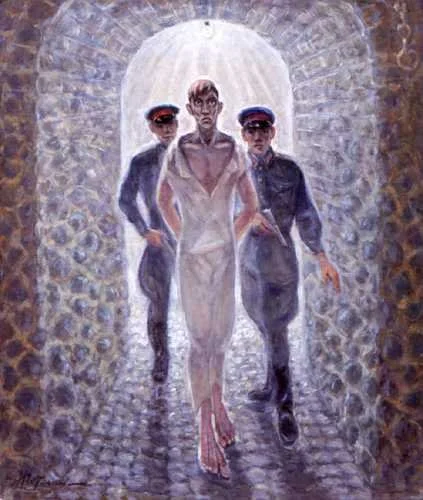
A painting by a survivor of the Holodomor and Stalin’s gulags. It could easily depict Julian the 9th being arrested by the Kalkars.
Considering when it was written, The Moon Men can stand proudly alongside most fictional critiques of Communism—especially considering how early he wrote it. Ed told it straight and true. The only criticism that could reasonably be leveled is that ERB foresaw a kinder and gentler Communist system administered by actual aliens from the Moon—as opposed to human Earthlings who should have some theoretical sympathy toward their fellow humans—than what actual history has proved. Ed has been called a ‘misanthrope’, but he was, apparently—despite his legendary imagination—unable to envision the moral abysses humans wanting to bring about ‘utopia’ are eager to sink to.
The poor bastards who survived Pol Pot’s regime would have begged for the ‘Kalkar treatment’ as seen in The Moon Men. The same goes for the wretched Romanians subjected to the Pitesti Experiment. Burroughs gets extra points for calling the game so early. He didn’t have Khrushchev’s denunciation of Stalinism or Solzhenitsyn to cheat off of.
A century later, who commands more moral authority? Who is/was more prescient? Burroughs or his critics? Burroughs or the Pulitzer Prize Board?
Regarding its literary/pop culture influence, The Moon Men was definitely an early example of the ‘Alien Invasion of Earth’ sub-genre. The Moon Men also presaged various ‘Communists Take Over America’ cautionary sci-fi tales. Perhaps the greatest flowering was in the 1980s, when movies like Red Dawn and book series like ‘The Survivalist’ did quite well. Such things were pooh-poohed by our social betters. I agree that the Soviets conquering the USA outright was somewhat dubious. However, ERB stated in The Moon Men that those who would later be labeled ‘useful idiots’ and ‘fellow travelers’ played a major role in bringing about Kalkar rule in America. That supposition is far from ludicrous.
The thunderous culmination of the Moon Trilogy is found in Edgar Rice Burroughs' "The Red Hawk". We’ll get to that, sooner than later.
*Chicago was where ERB was born and bred. He also used it as a setting for his highly influential novel, The Mucker.
The entire ‘Moon Trilogy’ review series:
Edgar Rice Burroughs' 'Moon Trilogy' -- One Hundred Years On