
Edgar Rice Burroughs' 'Moon Trilogy' -- One Hundred Years On
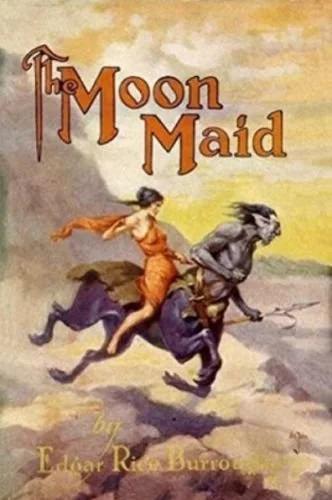
The first edition omnibus from 1926. Cover art by J. Allen St. John. A beautiful painting, as usual, but also the beginning of the ‘centauroid’ depiction of the Va-gas.
I meant to celebrate the centennial anniversary of Edgar Rice Burroughs' The Moon Maid back in 2023. I then missed the chance to praise the centennials of "The Moon Men" and "The Red Hawk" last year. February of 2026 is upon us and now I can express my admiration for Ed's entire 'Moon Trilogy', which was published as a hardcover omnibus one hundred years ago this month.
For those suffering from minor and major degrees of Spoilerphobia, now might be a good time to just scroll down to the art and then check out the actual texts, which are out there in various forms and have been for a century. Edgar Rice Burroughs, Incorporated--founded by ERB himself--published a beautiful centennial edition a few years ago. As it is, I will go into some depth regarding the plots and high points of the three tales as I see fit.
The origins of the Moon Trilogy are more convoluted than almost any other literary works from Burroughs. The central core of the series first arose in Ed's mind in 1919--less than two years after the horrific October Revolution in Russia. He wanted to write a tale called "Under the Red Flag". Here is a quote from Burroughs scholar, Robert B. Zeuschner:
"The genesis of the tale of THE MOON MAID begins at the end of 1918, and early into 1919. During this year Ed Burroughs was working on TARZAN THE UNTAMED, but took some time off to write a novelette inspired by the recent Bolshevik revolution in Russia.
In this tale, which he entitled 'Under the Red Flag,' Burroughs expressed his profound distrust of Russian Communism. Set two hundred years in the future, around 2125, it portrays Ed's guess of what might happen if the Soviet Bolshevik communists actually achieved world domination."
Ed took his story to the same pulp publishers who launched him back in 1912: Argosy/All-Story. Despite ERB's nearly spotless run of success for the past five-plus years, the Argosy editors turned him down. The Bolshevik Revolution was all the rage in the more sophisticated circles of New York at that point. In fact, very little but glowing praise regarding the Bolshevik regime was being published in the USA as a whole. ERB wasn't buying it--and would be proved right--but his editors demanded something more in line with A Princess of Mars.
In May of 1923, Argosy All-Story Weekly published the first installment of The Moon Maid. In it, we learn about Captain Julian the 5th and Lieutenant Commander Orthis, both of whom are vital to the mission sent to Mars in the year 2025. The spaceship, the Barsoom, was launched on Christmas Day, 2025. If only.
SPOILERS FOLLOW. These tales have been in print for over a century.
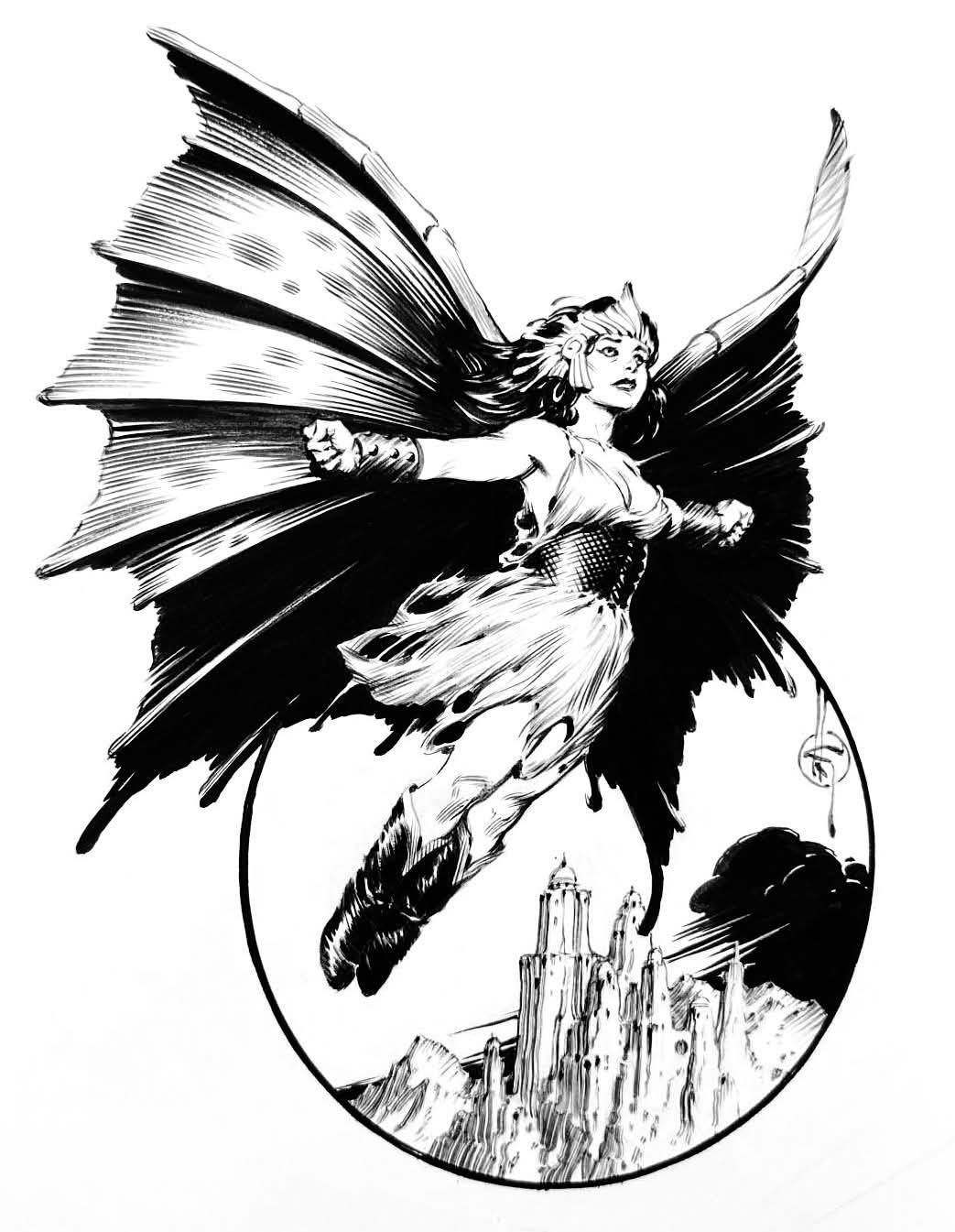
Na-hee-lah of Laythe, as depicted by Mark Schultz.
The Barsoom is barely beyond Earth's orbit when troubles arise, forcing a dive down into a Lunar crater. The five spacemen find themselves in the inner Lunarian world of 'Va-nah', which is roughly similar to Pellucidar, the 'Inner Earth' of ERB's At the Earth's Core (1914). Va-nah sports an inner sun and very limited flora and fauna. Somewhat like Mars/Barsoom, but with a central ocean like Pellucidar. Va-nah is dying.
Julian and his crew run afoul of the Va-gas (the term is singular and plural). The Va-gas are omni-carnivores. They eat other life-forms but also eat their own species.
The Va-gas are vaguely humanoid, cannibalistic quadrupeds. They run on all fours until they need to fight. At that point, they use their front arms/limbs to manipulate weapons attached to their harnesses. Imagine giant, six hundred pound baboons--who can only eat meat--with 80 to 90 IQ scores.
One thing I’ll note here is that, even at the very start, artists got the Va-gas wrong. Perhaps it was the multi-limbed beasts of ERB’s Barsoom or the centaurs of Greek mythology, but almost every artist until the 21st century has depicted the Va-gas incorrectly. As ERB described them, the Va-gas are quadrupeds, not hexapods. Even the mighty Frazetta got the details wrong. Check out the Va-gas gallery below.
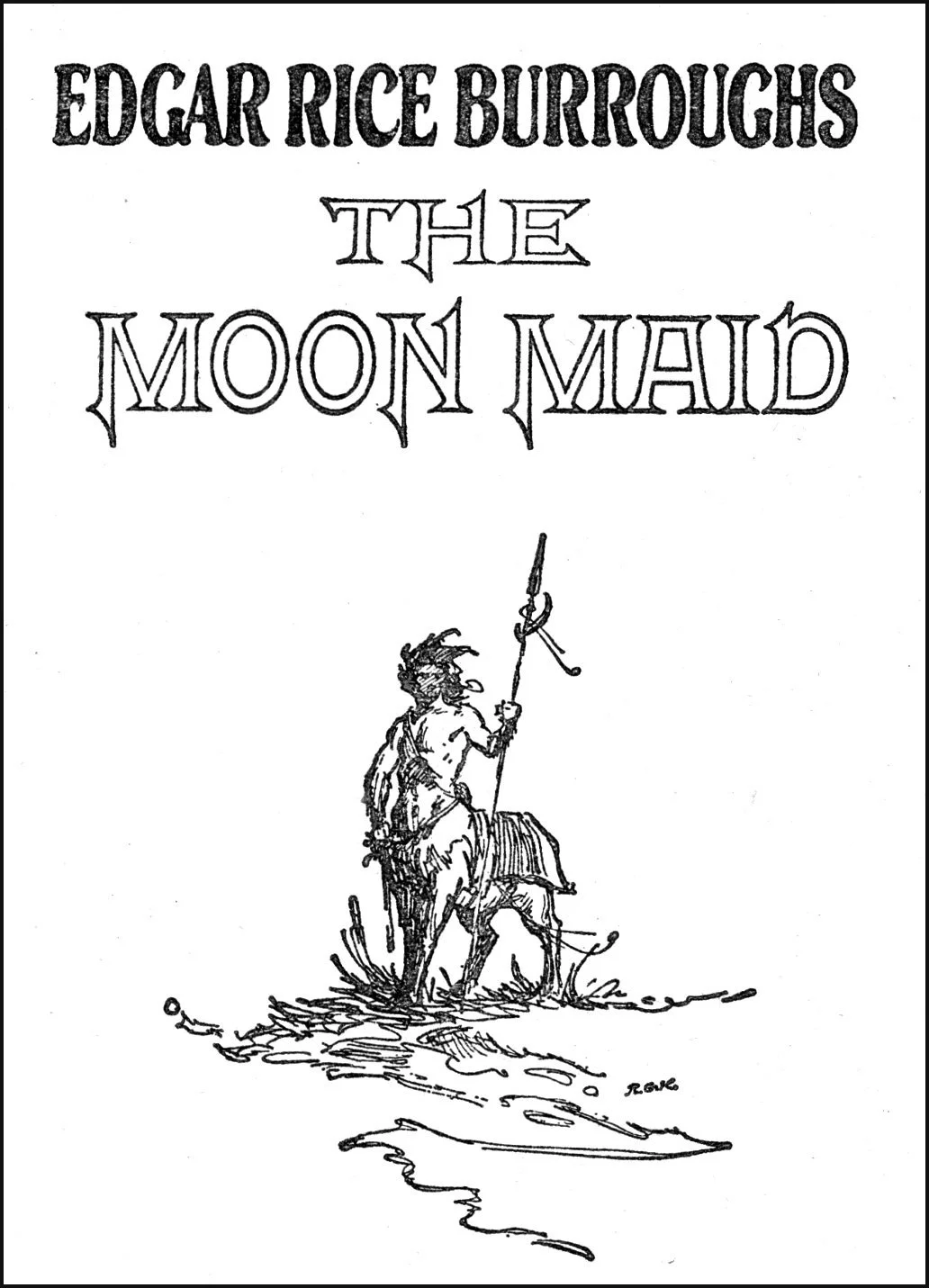
Roy G. Krenkel from the original Ace paperback edition.
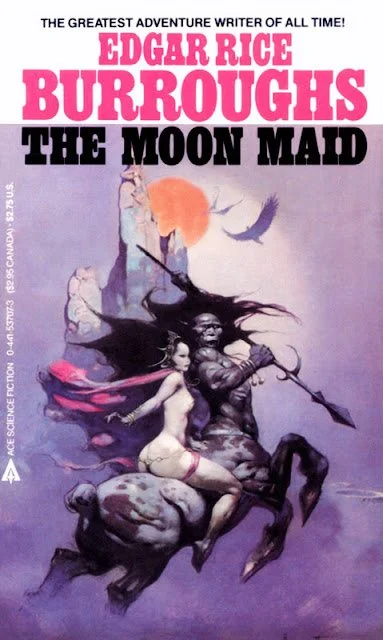
The classic ‘70s Frazetta cover.
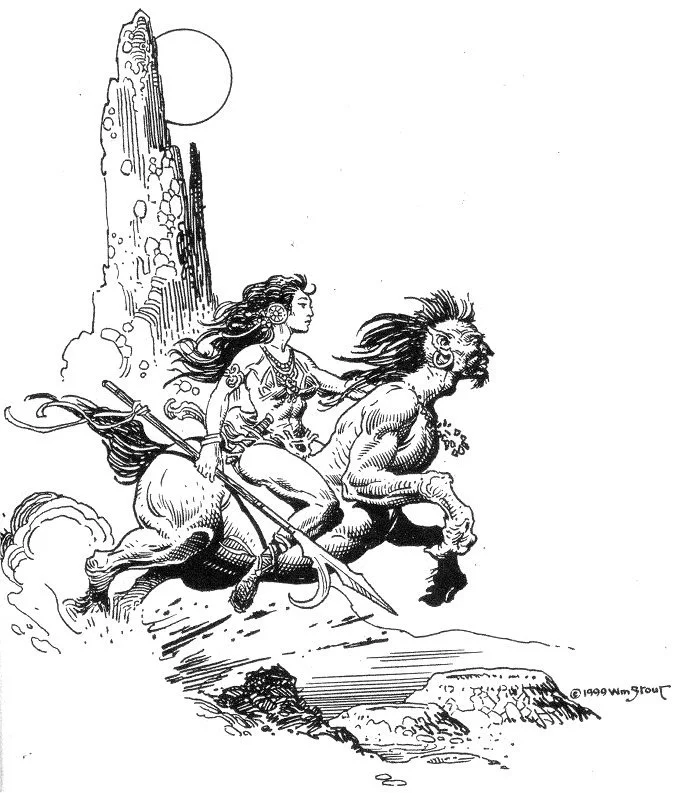
William Stout’s accurate rendition from 1999.
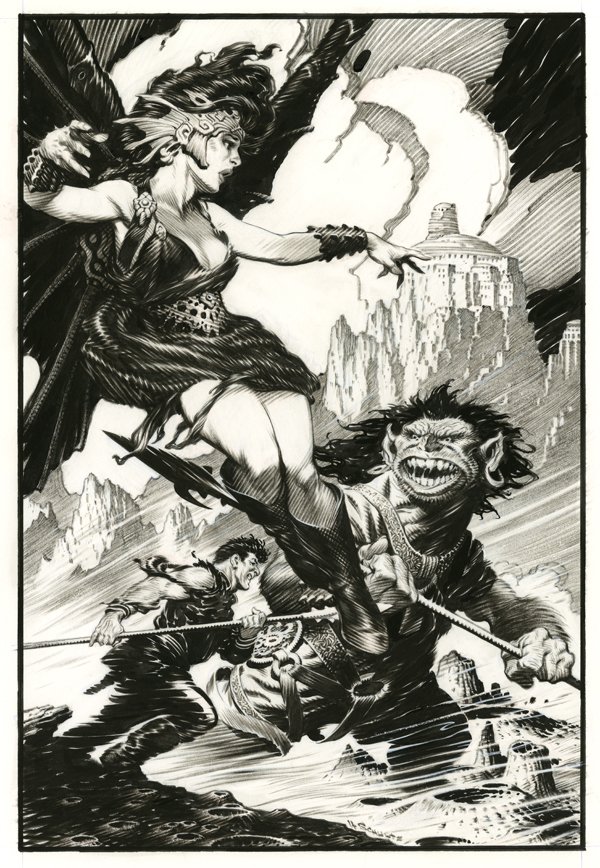
Nah-ee-lah and Julian versus a Va-gas by Mark Schultz.
So, the Va-gas capture Nah-ee-lah, the gorgeous princess of Laythe, one of the truly civilized lands of Va-nah. Her people fly with the aid of artificial wings and Lunarian gravity. A literal angel with a broken wing. Her ancestral people are the U-ga, an advanced, somewhat feudal civilization which was destroyed from within. Julian and Nah-ee-lah manage to escape. Check out this epic passage:
"She led me then straight into the mighty mountains of the Moon, past the mouths of huge craters that reached through the lunar crust to the surface of the satellite, along the edges of yawning chasms that dropped three, four, yes, sometimes five miles, sheer into frightful gorges, and then out upon vast plateaus, but ever upward toward the higher peaks that seemed to topple above us in the distance. The craters, as a rule, lay in the deep gorges, but some we found upon the plateaus, and even a few opened into the summits of mountain peaks as do those upon the outer surface of planets. Those in the low places were, I believe, the openings through which the original molten lunar core was vomited forth by the surface volcanoes upon the outer crust."
Julian and Nah-ee-lah search for her home-city of Laythe. They are captured by the Kalkars, the sect which has conquered the Lunarian world from the U-gah. Julian is imprisoned within a Kalkar gulag and learns the past history of Va-nah from a Laythean prisoner:
"[During the U-gah period] There were those who held high positions and those who held low; there were those who were rich and those who were poor, but the favors of the state were distributed equally among them, and the children of the poor had the same opportunities for education as the children of the rich, and there it was that our troubles first started. There is a saying among us that 'no learning is better than a little,' and I can well believe this true when I consider the history of my world, where, as the masses became a little educated, there developed among them a small coterie that commenced to find fault with everyone who had achieved greater learning or greater power than they. Finally, they organized themselves into a secret society called The Thinkers, but known more accurately to the rest of Va-nah as those who thought that they thought.
It is a long story, for it covers a great period of time, but the result was that, slowly at first, and later rapidly, The Thinkers, who did more talking than thinking, filled the people with dissatisfaction, until at last they arose and took over the government and commerce of the entire world. The Jemadars were overthrown and the ruling class driven from power, the majority of them being murdered, though some managed to escape, and it was these, my ancestors, who founded the city of Laythe. It is believed that there are other similar cities in remote parts of Va-nah inhabited by the descendants of the Jemadar and noble classes, but Laythe is the only one of which we have knowledge.
The Thinkers would not work, and the result was that both government and commerce fell into rapid decay. They not only had neither the training nor the intelligence to develop new things, but they could not carry out the old that had been developed for them. The arts and sciences languished and died with commerce and government, and Va-nah fell back into barbarism."
Obviously, the Kalkars are proto-Jacobins/Bolsheviks. Julian and Nah-ee-lah escape to the Barsoom and head back to the Earth. However, they learn that Orthis has allied with the Kalkars and is building a huge interplanetary fleet to invade his home planet.
The novel ends at that point. There are two more 'books' to go. For those wanting extra credit reading, I can only say that Swords Against the Moon Men by Christopher Paul Carey is the best pastiche I have ever read. It fills in the generational gap between The Moon Maid and "The Moon Men" almost perfectly.
Until then, Kaor!
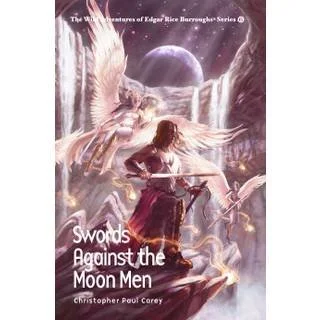
The entire ‘Moon Trilogy’ review series:
Edgar Rice Burroughs' 'Moon Trilogy' -- One Hundred Years On