
John Carter, Warlord of Marvel
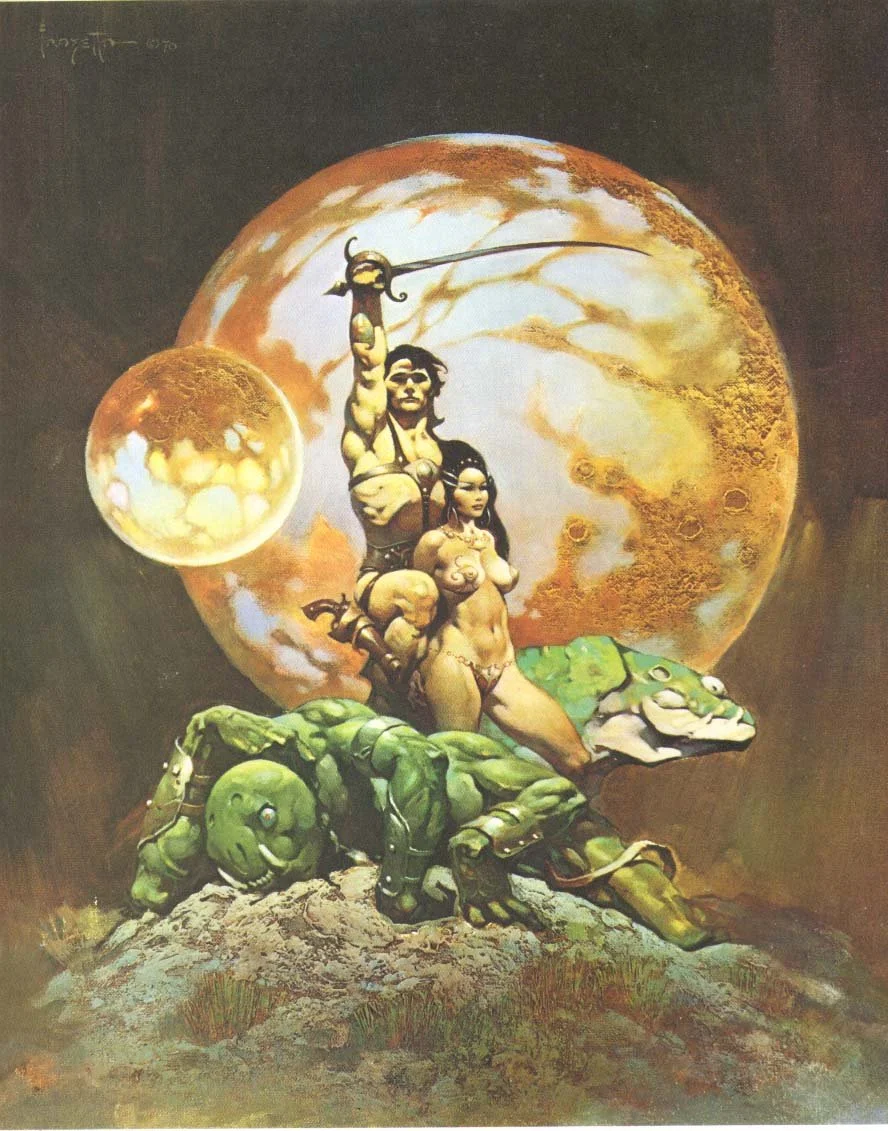
Frazetta’s classic painting for A Princess of Mars.
In a way I was born too late. Mars was already dead when I became interested in space, back in the mid to late 1980s. Mariner and Viking delivered the death sentence. Their cold, unsympathetic sensors put a final end to the Mars-that-was. Gone were the canals, the ruined cities, the desperate lost races struggling to survive. The real Mars was a dead world, or perhaps one which had never really lived, except in the imagination of mankind. By the 1980s, Edgar Rice Burroughs was not quite the cultural force he once was either. You could find his novels on spinner racks and drugstore bookshelves—and still could, up until the mid-‘90s when they dwindled away—but he certainly was not the massive publishing phenomenon he was in the ‘60s.
I learned of his Martian novels via an offhand reference in a book in my school library which I recall stating—inaccurately, as it turned out—that John Carter arrived on Mars by hatching from an egg. That reference was enough to get me to search out the series at the public library. Soon I discovered John Carter of Virginia and was transported with him to the dying world of Mars, known to its inhabitants as Barsoom. Like generations before me, I thrilled to Carter’s adventures among the green men of Mars, his befriending of Tars Tarkas, and his love for the incomparable Dejah Thoris. And Mars lived again, in the way that all stories do when read with new eyes.
Not long after discovering the novels, I learned there had been a comic version, which I was late to. I learned this through house ads in back issues of Marvel’s Star Wars comic, which had been cancelled just a few years earlier and I was collecting second-hand. So during my comic shop visits, I kept an eye open for the back issues of Marvel’s John Carter, Warlord of Mars.
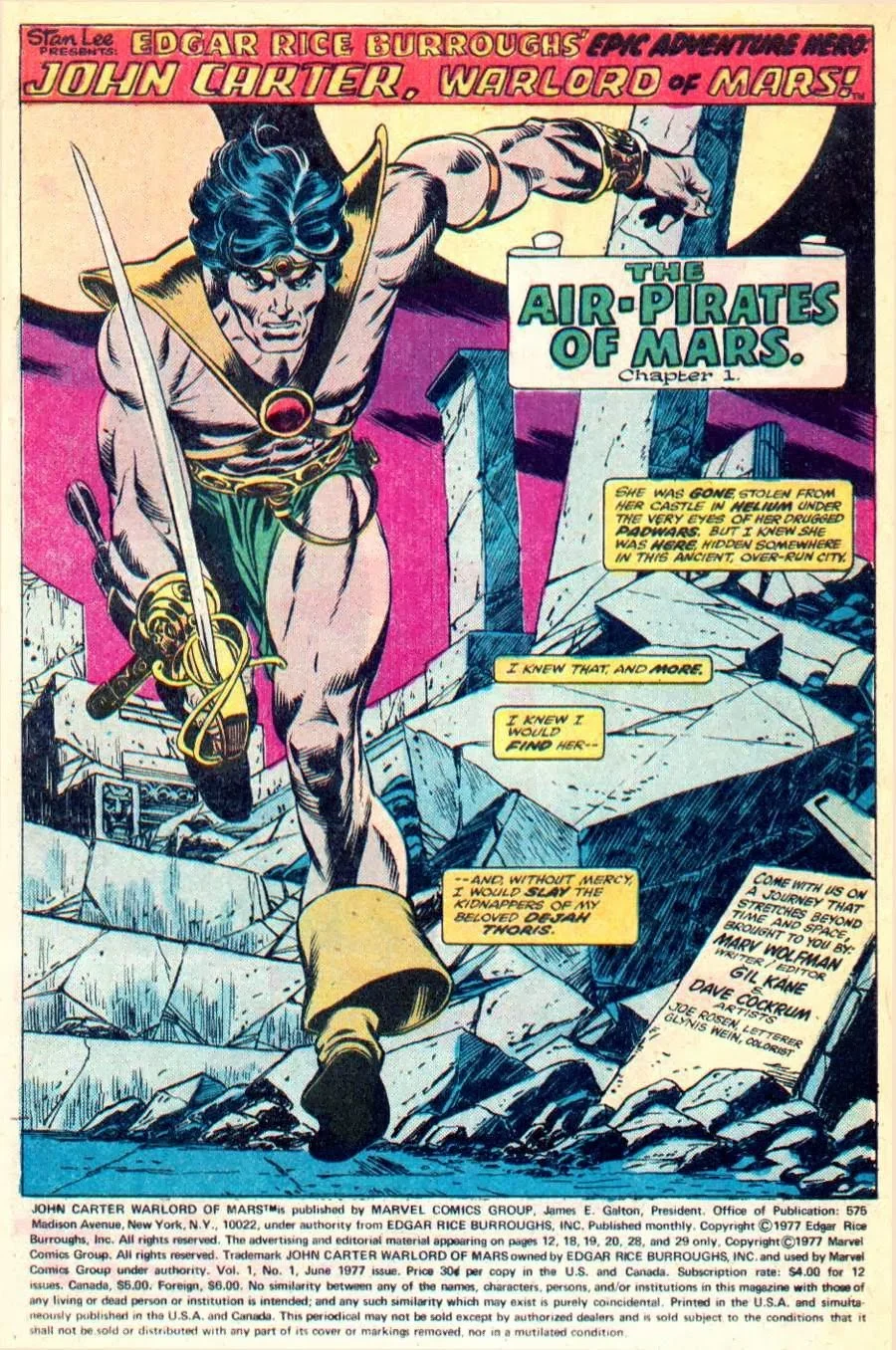
The splash page for John Carter, Warlord of Mars #1.
The title, which ran for 28 monthly issues and 3 annuals, started and ended the same time as Marvel’s concurrent Tarzan title. It can be divided into two parts: Marv Wolfman and Chris Claremont. Marv Wolfman had already written some John Carter stories when DC held the license a few years earlier. Then DC lost the license and ERB, Inc. briefly flirted with publishing their own comics, with Wolfman as one of the writers. But this fell through and Marvel ended up with the license instead. Roy Thomas, who grew up reading ERB, was originally tapped to write both John Carter and Tarzan. However, he decided to pass on Carter and allow another new Marvel writer to handle him: Marv Wolfman.
Wolfman made the decision to set the series in the time gap mentioned in passing in Chapter 27 of A Princess of Mars: “For nine years I served in the councils and fought in the armies of Helium as a prince of the house of Tardos Mors.” The idea was to present Carter with some back story, but not too much.
On art, Wolfman was paired up with the legendary Gil Kane who, for the first and eleventh issues only, had an assist from the wildly talented Dave Cockrum. It was the kind of artistic dream team one wishes could have lasted more than a month.
For the first ten issues, collectively “The Air-Pirates of Mars”, Carter is pitted against a mysterious mastermind known as “The Great One” and his chief minion, Stara Kan. The story kicks off, in true Burroughs fashion, with the incomparable Dejah Thoris being kidnapped—again. Dejah vu. Kidnapping the wife of John Carter—or of any other Burroughs protagonist, for that matter—is a death sentence, and yet the bad guys keep doing it anyway. They just never learn, I suppose.
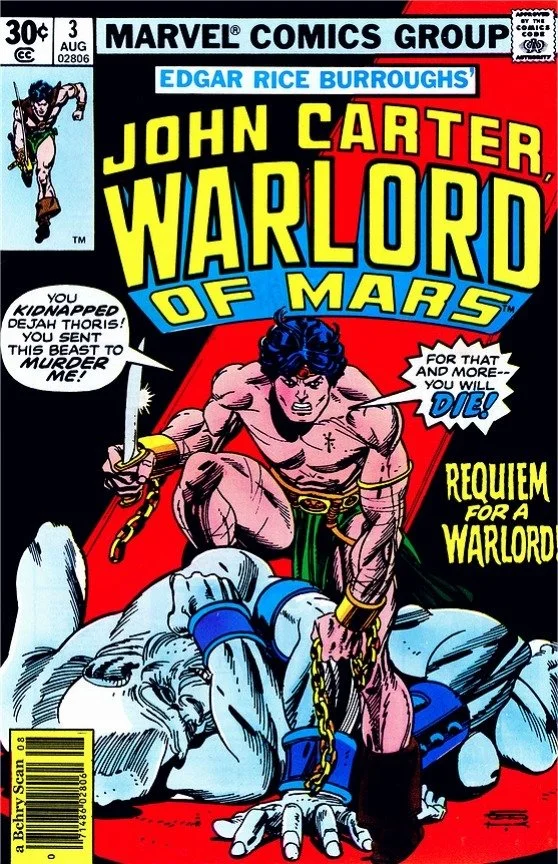
The ruins of Zodanga, the rival city-state destroyed utterly by Carter during the events of the first novel, is the setting for the first issue. Zodanga looms large in the backstory of Stara Kan, who was a soldier in service to the city before Carter took his arm. The mechanical replacement limb Stara Kan is given ends up playing a major part later on. Stara Kan embarks on a campaign of terror against Carter, not only holding his wife hostage, but also destroying Carter’s heroic reputation.
Tracking down Stara Kan is not Carter's sole tribulation. Stara Kan’s lies make the Earthman a pariah in Helium, forcing Carter to fight against his own adopted people while preventing the destruction of one of the precious incubators where the next generation of Heliumites are being gestated. Not long after, the minions of the Great One launch a nihilistic attack on the Atmosphere Factory upon which all of Barsoom depends.
After nearly a year’s worth of adventures, Carter finally comes face to face with the Great One. Wolfman’s main villain is a fascinating creation. A hybrid mutation who claims to have been the last living creature spawned from Barsoom’s Tree of Life, he is driven by his fanatical desire to save Barsoom. But not like Carter has. Instead the Great One wants to destroy most life on the planet in order to conserve resources for the few survivors. The finale is half epic infodump--as the Great One explains his origins and his plans in great detail--and half epic duel. It’s a credit to Kane as an artist that he is able to keep all this from bogging down since it’s a whole lot of tell, tell, tell.
From what I gather, there were some kind of creative differences between Kane and Wolfman, though I have no specific details as to the nature of them. This might explain why Kane departs after issue #11. I will point out that Kane and Wolfman would work together again over at DC in the early ‘80s, so it must not have been that big a beef. Overall, the feel of “Air-Pirates” is not too far off from the source material, with a breathless succession of kidnappings, escapes, desperate duels.
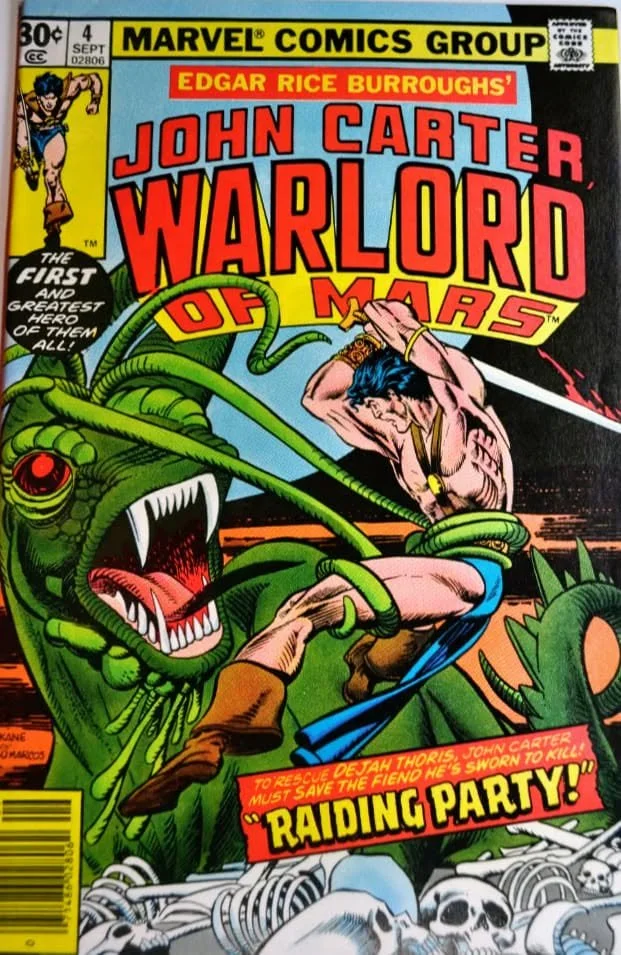
There are, however, some issues with these issues.
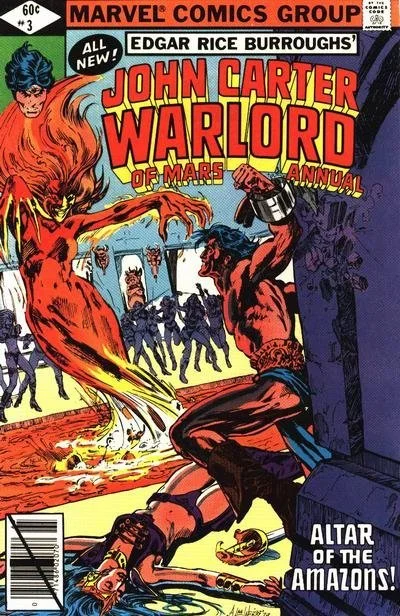
As readers of ERB might have gathered from that mention of the Tree of Life, something Carter is unaware of until the events of the second novel, there are some continuity issues between the comic and the originals. The first John Carter annual features an adaptation of “The Ancient Dead”, one of the novellas from Llana of Gathol, the tenth book, albeit without anything specific to Carter’s later life. I did love the annual, which was my first exposure to the artwork of Ernie Chan, whom I would get to know better when I discovered Conan a couple of years later. But that’s a whole other kettle of silians.
The biggest conflict of all would be the second annual, “The Headmen of Mars”, written by Bill Mantlo. In this story Carter ends up in Bantoom, the land of the hideous kaldanes, decades before his own daughter Tara ends up marooned there in Chessmen of Mars. Which I suppose is technically not precluded, but feels a bit unlikely. But not as unlikely as the inclusion of Ras Thavas, the Mastermind of Mars, who made his debut in the sixth book of the series. What makes his inclusion even more of a problem is that the art depicts Ras Thavas—who is a member of the dominant red-skinned humanoid race—as a kaldane. I have no idea if this was Mantlo’s error or if Chan mistakenly assumed he was and drew him accordingly and was never corrected. I would be curious to know what happened.
More than anything, the choice to set the series so early in the Carter canon opens the series up to these potential continuity conflicts. If the series had gone on and maintained that timeframe, how could Carter keep going on globe-spanning adventures without running across all the places he’s going to conquer in future installments? Fortunately, it did not go long enough for this to become a major problem.
Another issue is tonal conflicts. Some of Wolfman’s naming feels a bit off from ERB’s. “Stara Kan” works (though slightly confusing with the unrelated “Kantos Kan” running around), but names like “Grogg” and “T’ranna” are jarring.
Issue #8 features giant serpents made of vitalized stone which make a great visual but feel too Sword & Sorcery for the general super-science tone of the setting. But the art by Kane, an ERB fan for decades, strikes exactly the right note. He captures the essence of Barsoom perfectly, the mix of the romantic and the high-tech. The Barsoomian details are mostly accurate, albeit with some small gaffs. Thoats sometimes are depicted with reins, where in the novels they are guided by the telepathic commands of their riders. Also, Mars is much sandier than ERB describes, with little of the moss he specified. I guess that’s a bit of the real Mars intruding into ERB’s fantasy.
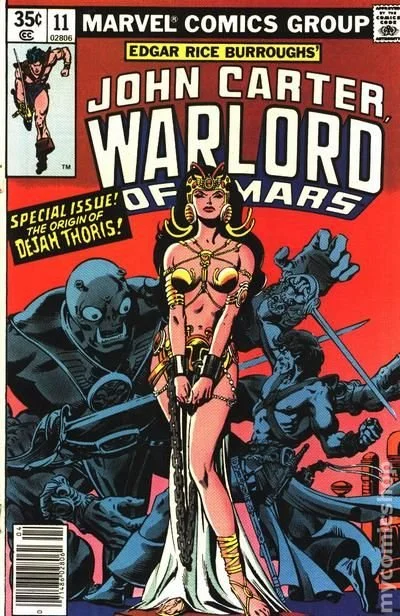
Classic cover by Kane and Cockrum.
One interesting innovation is the use of occasional brief flashbacks to Carter’s pre-Martian life, something ERB only hinted with references to “his strange, wild life in all parts of the world”. They don’t have much to do with his adventures on Barsoom, but they add a little spice.
The highlight for me was issue #11, where Wolfman adapts a small portion of Princess, pertaining to Dejah Thoris’s first meeting with Carter. Here we see what might have been had the title decided to focus on adapting the original novels outright and it’s glorious. The Dejah Thoris issue is followed up by a rather out-of-place 3-parter featuring a horde of animated skeletons led by a guy with the rather unlikely name of Zhuvan D’ark. Seriously. It feels a lot more Conan than Carter.
Wolfman ends his run with a rather odd one-off where Carter is trapped in a mind machine by a mad scientist and subjected to false memories of living in Earth’s history. For whatever reason, Wolfman does not take advantage of ERB’s backstory for Carter of him being possibly immortal, but instead inserts him into random, illusory historical events. And that’s all he wrote.
With issue #16, Chris Claremont takes the authorial reins. At the time, Claremont was a rising star, in the earliest years of his legendary run on The X-Men. Almost all of Claremont’s run (except the third annual) is taken up by the 12-part “Master Assassin of Mars”. It starts with a bang, with the Warlord seemingly struck down by poison (he isn’t of course). All with the bonus of a memorable page-spanning image of Dejah Thoris, in her skivvies with a sword, swearing vengeance. That’s the sort of image that stays with a guy on the cusp of adolescence, let me tell you.
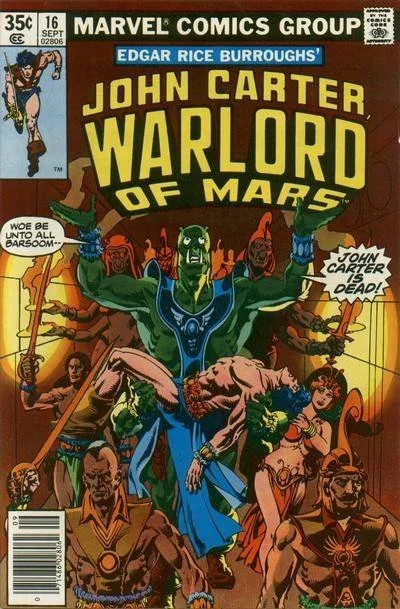
Through a series of adventures, Carter ends up marooned in the Vallis Marineris, a feature of Martian geography that had only been discovered in the previous decade by the Mariner probes and was something of which Burroughs had no knowledge. He certainly would have used the Grand Canyon of Mars had he known and its inclusion here is one of Claremont’s best ideas on the title.
The immense valley is home to a lost race, in this instance, a winged offshoot of the Orovars. Could Claremont have been intentionally homaging the Hawkmen of Flash Gordon, a comic strip that itself owed a lot to Burroughs? Maybe.
The inverted cavern city of Karanthor is a masterstroke and Colan’s rendition of it in issue #17 is the artistic highlight of his tenure on the title. It’s a fantastic creation, worthy of Burroughs. Another highlight is Carter and Dejah’s long, arduous climb out of the canyon. Along the way we learn that Carter once visited the Himalayas. There is also a brief but charming sequence of panels where he fantasizes about escorting Dejah Thoris to a Virginia ballroom dance.
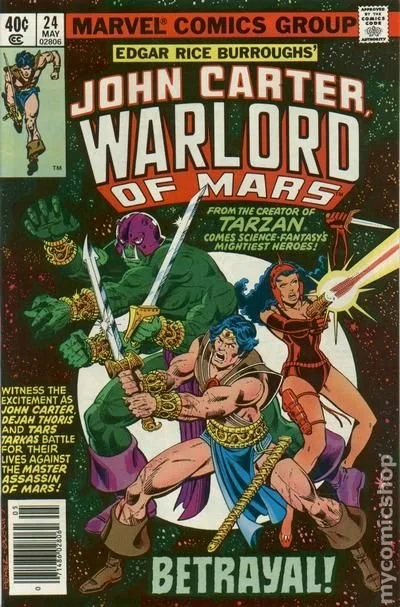
Cover by George Perez.
When the villain of this story arc, Tal Mordin (the titular Master Assassin), is unveiled, we learn he is yet another misguided idealist trying to save Barsoom from itself. Having another villain with similar motives to the previous villain makes it feel like the series is already going around in circles, which is not what you want in aseries that’s only two years old.
Issue #24 ends with an ominous final page of Dejah Thoris imprisoned in a dungeon and the ominous blurb: “Is This The End? See our letters page for an important message!” The message begins, “We must regretfully state that this is the last issue of JOHN CARTER, WARLORD OF MARS . . . at least for the forseeable future.” It goes on to give a vague apology for the cancellation, citing “the intricacies of magazine publishing”.
But this was not the end. Because a few months later, issue #25 comes out, with the blurb: “He’s Back!” So what happened? That is a good question. I did some poking around but could not find a solid answer.
Here’s my guess based on scanty evidence and supposition: I don’t know much about the license from ERB, Inc, but I do remember hearing that they demanded a high royalty fee, which meant that Tarzan and Warlord needed high sales to turn a profit, which they did not. So poof goes Warlord’s license. Marvel, having the scripts and possibly some of the art for the next few issues already begun/finished, and not wanting to waste them, negotiated a deal with ERB, Inc. to finish the story. Which accounts for the deterioration of the artwork and a raft of fill-in inkers as the series ends.
This is all supposition, of course. If anybody does have the inside scoop, or if they were involved in some manner, please feel free to tell us in the comments below.
As the series runs down, the lack of a consistent inker—and later artist—really take their toll. Colan’s art is good (at least when inked well), but there’s something about his rendition of Barsoom that never really comes to life the same way Kane’s does. Hard to put my finger on exactly what it is, but his Barsoom is just a little too Earthly at times. As a sidenote on the art, issue #18, a solo story of Tars Tarkas, features the first Marvel work of an artist who was just a few years away from becoming a household name—Frank Miller.
The regular issues peter out with a ho-hum fill-in by Peter Gillis with art by Larry Hama and Ricardo Villamonte, along with the last annual by Claremont. And thus, the Marvel adventures of John Carter drew to a close. Or did they?
After reading all the issues of the Warlord of Mars, I realized that I had actually been exposed to something from the series without my realizing it… in the pages of Marvel’s Star Wars series.
You see, in issues #53-#54, Princess Leia crash lands on Shiva IV, a remote, primitive planet menaced by the Empire. Leia notes in her internal monologue: “Curious—these people fight with swords, yet fly anti-gravity hovercraft! The mix doesn’t make sense.” The tone of the story felt jarringly different, almost as if it belonged to another series altogether. And it was written by none other than Chris Claremont.
So, when Warlord of Mars ended, Claremont had begun another story, and Carmine Infantino had done some of the artwork for it. The pages of artwork were retained after the cancellation and when a fill-in was required they had s skeleton on which to build the flesh of the story. Claremont had already done a few stories for Star Wars, including the first annual, so he was already familiar with both settings. Reading these issues with Barsoom in mind, things become clear: Shiva IV=Mars, Aron Peacebringer = John Carter, Keral Longknife = Tars Tarkas, Alisande=Dejah Thoris.
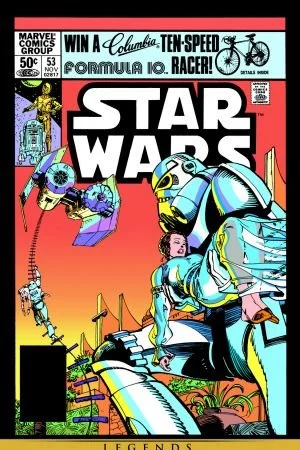
Cover by Walter Simonson.
Looking carefully, you can see that Keral’s race of tall orange humanoids have torsos that look as if they could accomodate a second pair of arms. Which of course they did, in the original art. A crocodilian pet in Aron’s house was doubtless originally Woola, Carter’s faithful Martian “dog”. Also of note is the first person narration from Aron:
“K’avor was destroyed because it supported the upstart, Aron Peacebringer, who’d dare to smash the ancient war god’s death cults and slay their priests.”
Hmm. Now, this is all very reminiscent of the second and third novels of the series, in which Carter overthrows the false religion of Issus. But Marvel’s comic was set before all that. I’m guessing CC was giving Aron some backstory similar to that of his fictional precursor. Claremont cleverly splits Carter’s role between Aron and Leia.
Aron is a warlord who is married to the most beautiful woman on the planet. Despite not having any gravitational advantages, Aron in a few panels performs superhuman leaps, just like Carter. On the other side, Leia is the outsider from another world, thrust into an unfamiliar setting where her unfamiliarity with the language, customs and politics prove dangerous.
In the second part, the story is increasingly taken over by the more conventional elements of the Star Wars setting, with Shiva IV fading into the background. We do get a brief bit of Keral and Chewbacca fighting side by side, though.
Was Chris Claremont cleverly paying homage to one of the inspirations for Star Wars, or was he just being thrifty in recycling a half-finished story? I suppose it could easily have been both. And Claremont wasn’t quite done with the Warlord just yet.
The X-titles were never really my thing growing up (though I have read some of the collections of the classic story arcs since then). By the late 1980s, Claremont was the reigning king of comics, with the X-titles dominating the sales charts.
One of the innumerable spinoffs of The X-Men was Excalibur, also written by Claremont. Excalibur, in brief, was the British-focused offshoot of the American X-teams, with a mix of American and British characters and an emphasis, in the early years, on more light-hearted adventures. One of those was the “Cross-Time Caper”, which saw the team catapulted across the multiverse.
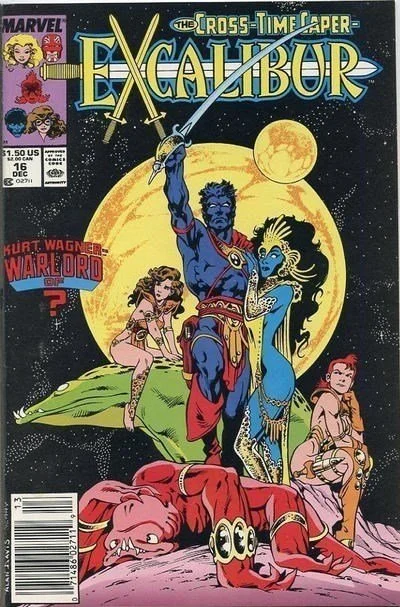
The story in question begins with issue #16, which either by chance or by choice was the exact same point in Warlord of Mars that CC began his run. The cover makes the roots of the tale perfectly clear. Kurt’s pose is an homage to Frank Frazetta’s A Princess of Mars painting and the blurb for the story is clearly patterned on Marvel’s Warlord logo.
That issue's story, appropriately titled “Warlord”, the members of the team get dumped on a world with twin hurtling moons, inhabitants who favor scanty clothing and fight with swords despite having advanced airships. As if that wasn’t enough, Kitty Pryde and Rachel Summers fight off a four-armed, red-skinned giant. There’s also a race on the planet who resemble white-furred gorillas with two arms instead of four. Readers of ERB will doubtless recall the White Apes of Barsoom. While the story itself doesn’t adhere to the Burroughsian formula, the imagery alone makes it a worthy footnote to the Marvel adventures. Issue #17 takes place in the same world, but the plot has even less to do with ERB than the first half and is not relevant to this post. It’s nice to see that his stint on the earlier, shorter-lived title was apparently a fond enough memory to revisit a few years down the line.
ERBZine has scans of every issue of Marvel’s Warlord of Mars here and they’re in color to boot: ERBzine 6860: CONTENTS. John Carter: Warlord of Mars.
Any story is a new one if you have never read it. It’s never too late to discover that which came before. And when you do, you find that the old stories still live.