
Cormac FitzGeoffrey: Howard's Mighty Irish Crusader
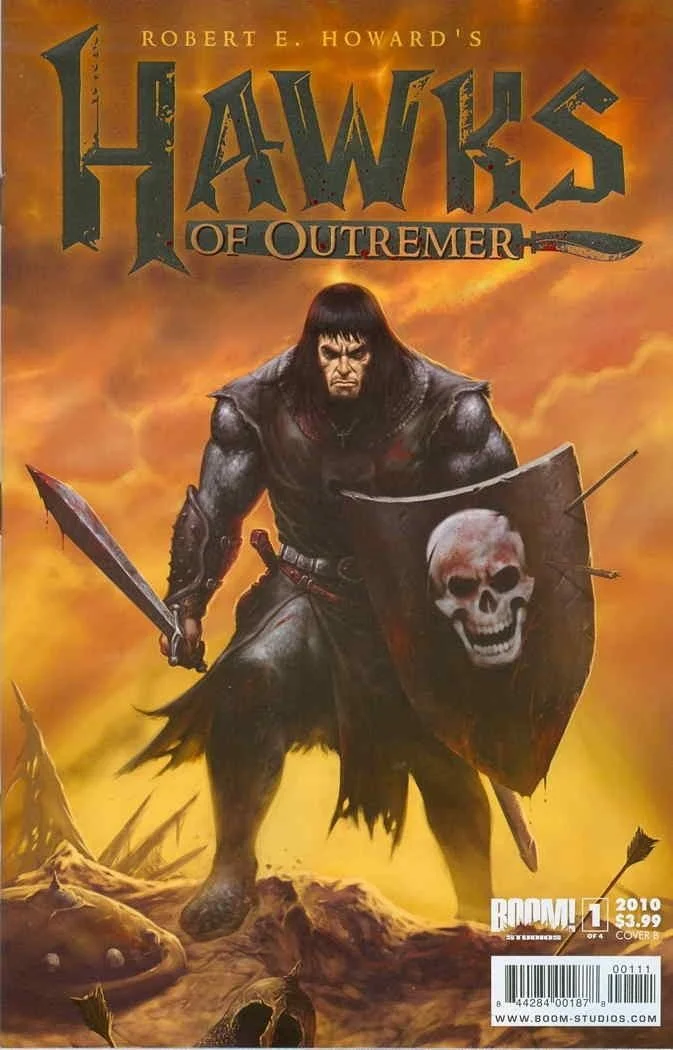
Cormac as portrayed by Joe Jusko.
Cormac FitzGeoffrey is perhaps the most notable of all the protagonists that Robert E. Howard created in his ‘Crusader’ stories; tales written with a significant element of historical realism. Cormac is reminiscent of Conan: tall stature, tigerish strength, fierce blue eyes, jet-black hair…and a force of nature on the battlefield.
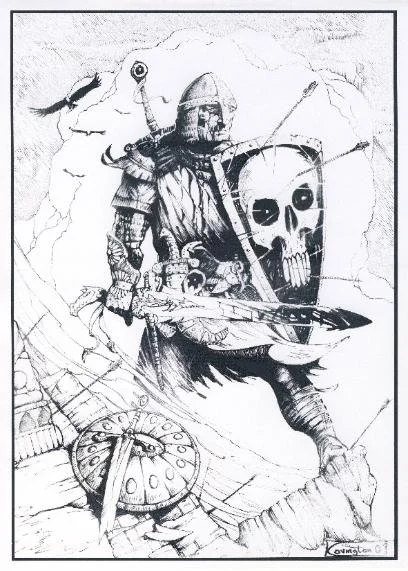
Cormac is an Irish crusader (half Gaelic, half Norman) of noble blood, a renegade with no lord over him (he even refused to swear fealty to Richard the Lionheart). His shield is a shining silver skull on a black background, and he carries a blue steel sword engraved with runes, taken from the corpse of a Norse king, the slayer of Cormac's brother during a Viking raid on Munster.
Some influences on Robert Howard's Cormac Fitzgeoffrey stories would be: Harold Lamb, (the beginning of ‘Hawks of Outremer’ resembles the beginning of the second chapter of ‘The Making of the Morning Star’), the book Crusade by Donn Byrne (the protagonist is half Norman ) and The Brethren by H. Rider Haggard, whose plot resembles ‘The Slave Princess’, along with other plot elements.
After writing ‘Red Blades of Black Cathay’ in collaboration with Tevis Clyde Smith, REH wrote a solo Crusader tale, which he mentioned in a letter to his friend, Harold Preece:
"I lately sold a tale to Oriental Stories in which I created the most somber character I have yet attempted. The story is called ‘Hawks of Outremer,’ and I got $120 for it."
That character was Cormac FitzGeoffrey:
“Clean shaven and the various scars that showed on his dark, grim face lent his already formidable features a truly sinister aspect. His low, broad forehead was topped by black, square cut hair that contrasted strongly with his cold blue eyes. Son of a woman of the O’Briens and a renegade Norman knight, Geoffrey the Bastard, in whose veins, it is said, coursed the blood of William the Conqueror, Cormac had seldom known an hour’s peace or ease in all his thirty years of violent life. Hated by the Irish and despised by the Normans he had paid back contempt and ill treatment with savage hate and ruthless vengeance.” — REH to Harold Preece, circa October 1930
Robert E. Howard places Cormac's birth in 1162 in the fragment, ‘The Slave Princess,’ where he indicates that Cormac participated in the Battle of Dublin at the age of eight. Howard suggests that Cormac was the son of Geoffrey the Bastard, a renegade Norman, who was supposedly a descendant of William the Conqueror, and "a woman of the O'Briens," Radharc O'Brien, a descendant of Brian Boru himself.
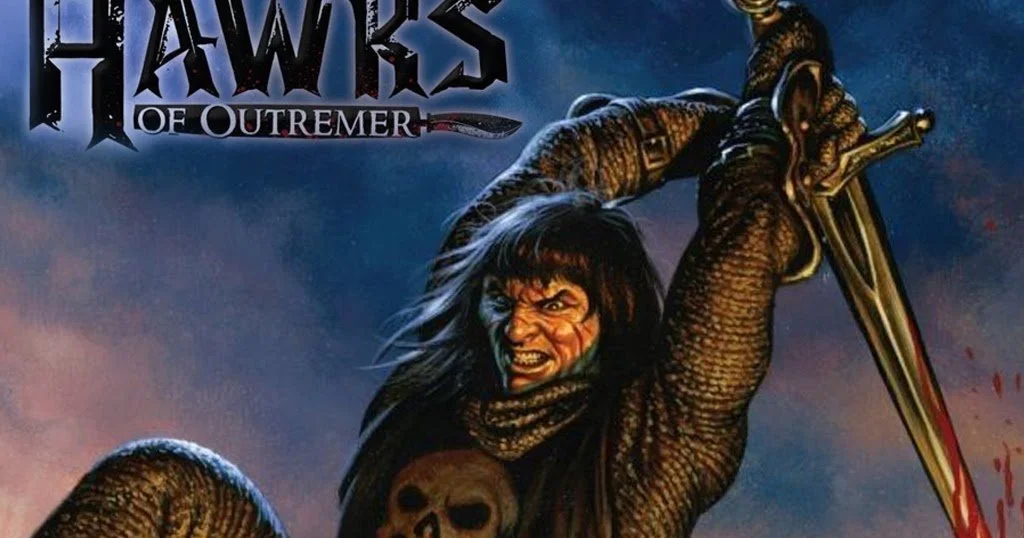
'Hawks of Outremer', the first Cormac FitzGeoffrey story, is basically a chronicle of vengeance. The beginning of 'Hawks of Outremer' is very similar to the second chapter of Harold Lamb's 'The Making of the Morning Star'. That chapter reads, in part:
'Robert, who was mightily hungry, struck the bars of the peep-hole with his mailed fist. In the hall of the main keep he knew that Hugo, his liege lord, Marquis of Montserrat and master of Antioch, sat at table with a goodly company. And the castellan was eager to greet his peers, who thought him dead after an absence of two years in Egypt, and to satisfy his hunger.
“Ho, the gate!” he shouted. “Open in the name of Montserrat.”
But the face of the warder that peered through the barred opening in the portal did not withdraw.“Thy name! And thy companion's name! Small thanks would be ours, I trow, if we unbarred to a Saracen after sundown.”
“Sir Robert, castellan of Antioch, am I—Longu' espée, Longsword, forsooth. And he with me is a paynim minstrel with a song for the marquis. What now?"
Robert's mustache twitched in a grin of amusement as he heard an exclamation, followed by whispered voices. Other faces pressed to the bars to scrutinize him in the dim light.
“Out upon thee for a lying wight,” growled one. “Sir Robert was racked, carted and buried by the accursed Mamelukes.”
Behind the gate was heard the grinding clink of a cross-bow, wound up to speed a shaft.
Robert turned to Abdullah.“Minstrel, are you resolved to enter this hold? Methinks they give but an ill welcome to wayfarers—though Hugo loves well a good tale and a tuneful voice. Forget not that I stand in no way your protector, and what befalls is e'en your hazard.”
“So be it.”
“——'s death!” Robert kicked the gate impatiently. “Set wide the gate and make an end of words. Fetch a cresset, varlets, or I'll set the pack of you aswim in the moat.”
Someone remarked that this sounded rarely like the Longsword, and a torch was brought while they examined the visitors. Then the bars were let down slowly, and Robert pushed inside, followed by Abdullah. A bearded captain of the warders crossed himself with a muttered—“Mary preserve us—'tis he!”
The men who were lowering the drawbridge glanced at each other and whispered behind their hands, and it was several moments before the castellan and his companion dismounted in the courtyard and were greeted by a staring squire.
Word of their arrival had passed to the main hall before them. A slim poursuivant who bowed low at the door seemed to share the general hesitation in announcing them, and Robert was fain to chuckle again at the bewilderment of those who greeted him.
At the end of the lofty hall candles gleamed on the table set on a dais for the master of the castle and his guests, and here a man stood up to peer over the candles as the knight strode forward between the long tables of the henchmen and commoners.
“Madre a Dios!” His broad, olive face paled, and he grasped the arm of his chair. “If ye be a spirit, why—why, know then that I have mourned you right hardily, having given to the shave-pates a ten shekels, aye, and thirty soldi for clank of bell and patter of prayer for this your soul. If ye be Sir Robert, lad, i' the flesh, why——”
“That am I, and sharp-set with hunger into the bargain.”
“Ha, that would be the Longu' espée. Why—boil me, lad, but we heard that you were cut down at the gate of Damietta. Aye, a Templar saw you carried within, and shortly thereafter your bare body hung out on the wall headless, to despite your comrades.”
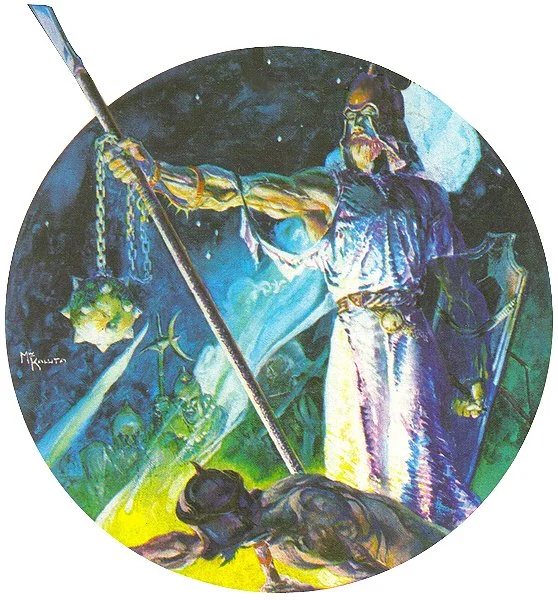
Sit Robert Longsword, as depicted by Michael Wm. Kaluta.
Now compare that to the beginning of 'Hawks of Outremer':
“Halt!” The bearded man-at-arms swung his pike about, growling like a surly mastiff. It paid to be wary on the road to Antioch. The stars blinked redly through the thick night and their light was not sufficient for the fellow to make out what sort of man it was who loomed so gigantically before him.
An iron-clad hand shot out suddenly and closed on the soldier’s mailed shoulder in a grasp that numbed his whole arm. From beneath the helmet the guardsman saw the blaze of ferocious blue eyes that seemed lambent, even in the dark.
“Saints preserve us!” gasped the frightened man-at-arms, “Cormac FitzGeoffrey! Avaunt! Back to Hell with ye, like a good knight! I swear to you, sir—”
“Swear me no oaths,” growled the knight. “What is this talk?”
“Are you not an incorporeal spirit?” mouthed the soldier. “Were you not slain by the Moorish corsairs on your homeward voyage?”
“By the accursed gods!” snarled FitzGeoffrey. “Does this hand feel like smoke?”
He sank his mailed fingers into the soldier’s arm and grinned bleakly at the resultant howl.
“Enough of such mummery; tell me who is within that tavern.”
“Only my master, Sir Rupert de Vaile, of Rouen.”
“Good enough,” grunted the other. “He is one of the few men I count friends, in the East or elsewhere.” (...)
Sir Rupert de Vaile, once of Rouen, now a lord of the fast-fading Outremer, turned as the great form bulked in the doorway. Cormac FitzGeoffrey was a fraction of an inch above six feet, but with his mighty shoulders and two hundred pounds of iron muscle, he seemed shorter. The Norman stared in surprized recognition, and sprang to his feet. His fine face shone with sincere pleasure.
“Cormac, by the saints! Why, man, we heard that you were dead!”
Howard drew much inspiration from Harold Lamb for his tales of the Crusades, although his main inspiration for this character was The Brethren by H. Rider Haggard.
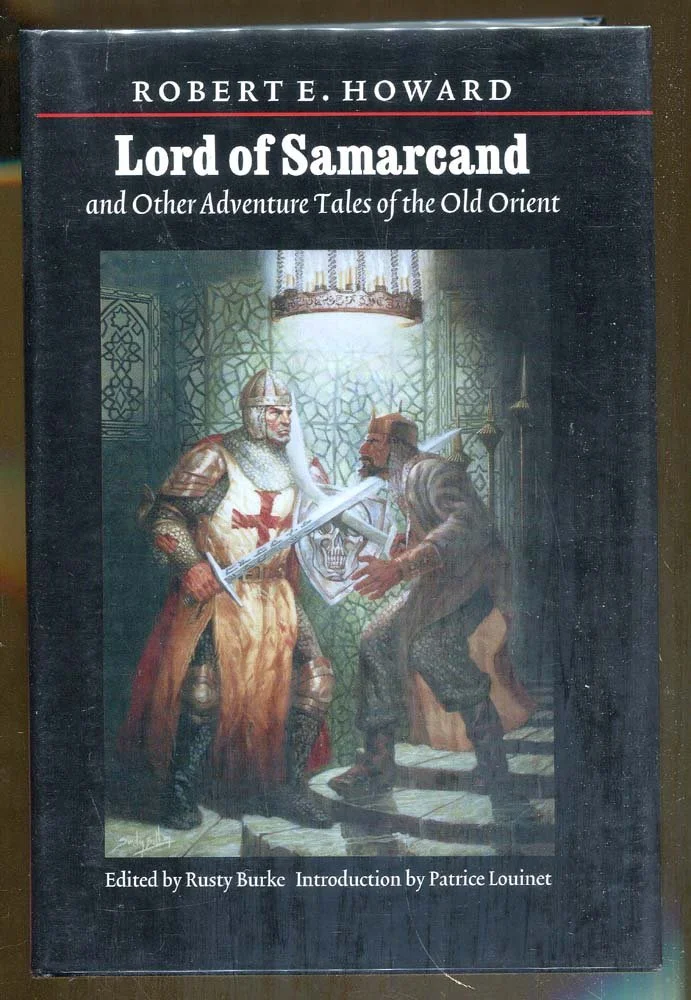
This cover depicts CFG about half-way through ‘The Blood of Belshazzar’.
In the short story "The Blood of Belshazzar," Cormac searches for a cursed gem of great value to pay the ransom for the Seneschal of Antioch, who is being held captive by his enemies. Al Harron said of this story:
' “The Blood of Belshazzar” is one of those Howard tales I feel is just too short to contain its many ideas, characters and story, one that would benefit greatly with an expansion to novellette: something along the length of “The People of the Black Circle” or perhaps even '“Skull-Face.”
Certainly the wide cast of characters would put many high-fantasy doorstoppers to shame, and the history of the malevolent jewel is grand enough to allow for an expanded narrative.'
It's true. Look at the large number of sinister characters described:
'There, for instance, was a Lur, hairy as an ape, tearing at a half-raw joint of meat with yellow fangs like a wolf’s. Kadra Muhammad, the fellow’s name was, and Cormac wondered briefly if such a creature could have a human soul. Or that shaggy Kurd beside him, whose lip, twisted back by a sword scar into a permanent snarl, bared a tooth like a boar’s tusk. Surely no divine spark of soul-dust animated these men, but the merciless and soulless spirit of the grim land that bred them. Eyes, wild and cruel as the eyes of wolves, glared through lank strands of tangled hair, hairy hands unconsciously gripped the hilts of knives even while the owners gorged and guzzled.
Cormac glanced from the rank and file to scrutinize the leaders of the band—those whom superior wit or war-skill had placed high in the confidence of their terrible chief, Skol Abdhur, the Butcher. Not one but had a whole volume of black and bloody history behind him. There was that slim Persian, whose tone was so silky, whose eyes were so deadly, and whose small, shapely head was that of a human panther—Nadir Tous, once an emir high in the favor of the Shah of Kharesmia. And that Seljuk Turk, with his silvered mail shirt, peaked helmet and jewel-hilted scimitar—Kai Shah; he had ridden at Saladin’s side in high honor once, and it was said that the scar which showed white in the angle of his jaw had been made by the sword of Richard the Lion-hearted in that great battle before the walls of Joppa. And that wiry, tall, eagle-faced Arab, Yussef el Mekru—he had been a great sheikh once in Yemen and had even led a revolt against the Sultan himself.
But at the head of the table at which Cormac sat was one whose history for strangeness and vivid fantasy dimmed them all. Tisolino di Strozza, trader, captain of Venice’s warships, Crusader, pirate, outlaw—what a red trail the man had followed to his present casteless condition! Di Strozza was tall and thin and saturnine in appearance, with a hook-nosed, thin-nostriled face of distinctly predatory aspect. His armor, now worn and tarnished, was of costly Venetian make, and the hilt of his long narrow sword had once been set with gems. He was a man of restless soul, thought Cormac, as he watched the Venetian’s dark eyes dart continually from point to point, and the lean hand repeatedly lifted to twist the ends of the thin mustache.
Cormac’s gaze wandered to the other chiefs—wild reavers, born to the red trade of pillage and murder, whose pasts were black enough, but lacked the varied flavor of the other four. He knew these by sight or reputation—Kojar Mirza, a brawny Kurd; Shalmar Khor, a tall swaggering Circassian; and Jusus Zehor, a renegade Georgian who wore half a dozen knifes in his girdle.'
Although it is a good tale, with that gallery of characters it would be even better if Howard had gone into more depth. The story sold for $115 to Oriental Stories.
The third and final story, 'The Slave Princess', is an unfinished tale clearly based on The Brethren by H. Rider Haggard. Robert Weinberg said this about it:
'What we have of “The Slave Princess” would make any other writer shake his head a little in wonder. In first draft form it’s as polished as most finished pieces by other authors. There are occasional moments where an adjustment would have been called for – FitzGeoffrey’s retelling of his early battles goes on for far too long near the fragment’s conclusion – but it’s a rough draft, and an impressive one. It starts with a bang and flows smoothly from scene to scene.
FitzGeoffrey may not be likable, but he fascinates, which is more than he did in the first two stories. He’s a shrewd schemer, a mighty warrior who has been shaped by his tumultuous past and genetics into more a force of nature than a normal human.'
It's a shame Robert E. Howard didn't write more about Cormac…although he did mention one further FitzGeoffreyan exploit in another of his Crusader tales.