
Nothing But Mud Remains: The Failure of George Pal’s Atlantis, The Lost Continent
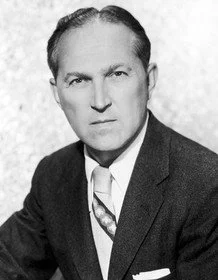
On paper it must have looked like a sure thing, the producer of some of the most ambitious science-fiction movies of the 1950s, tackling the ancient story of the doomed continent of Atlantis. Alas, a series of poor decisions and bad timing helped to sink the project almost before it began.
1961’s Atlantis, the Lost Continent, was the work of George Pal, one of the most accomplished creative minds of 1950s science-fiction filmmaking. Born György Pál Marczincsak, Pal moved Stateside and Anglicized his name. Pal’s cinematic career started off with a series of stop-motion shorts for children known as Puppetoons. At the dawn of the 1950s he got into producing and/or directing lavish live-action science-fiction films, starting with 1950’s Destination Moon, continuing with When Worlds Collide, The War of the Worlds and The Conquest of Space. At their best, the movies of George Pal are spectacular science-fictional epics that still hold up decades later. At their worst they are . . . interesting. Atlantis, the Lost Continent is very interesting in its failure. How this failure happened is a story unto itself.
The credited source of the movie’s story is the unproduced opera Atalanta: A Story of Atlantis—A Fantasy with Music, by Sir Gerald Hargreaves, published in 1948. The opera is obscure and details are hard to come by, but I’ve pieced together what I can from various sources. Atalanta is set after the Trojan War and a number of Iliad characters figure into it, including Ulysses, who should be lost and Agamemnon, who should be dead. So you can see off the bat that strict fidelity to mythology is not on the table. One of the ideas Hargreaves pursues is that Troy was a colony of Atlantis and when the Greeks destroyed Troy, they provoked the Atlanteans. The conflict between the ancient Greeks and the Atlanteans is straight out of Plato, minus the Troy angle. The title comes from the Atlantean princess, who has the title of “the Atalanta” and will not wed any man but the one who can beat her in a footrace. I have to assume that Hargreaves associated the mythological Atalanta with Atlantis solely on the basis of the similarity in names: no such connection exists in Plato. The princess is shipwrecked in Greece, which is one of the few plot points the movie version directly lifts.
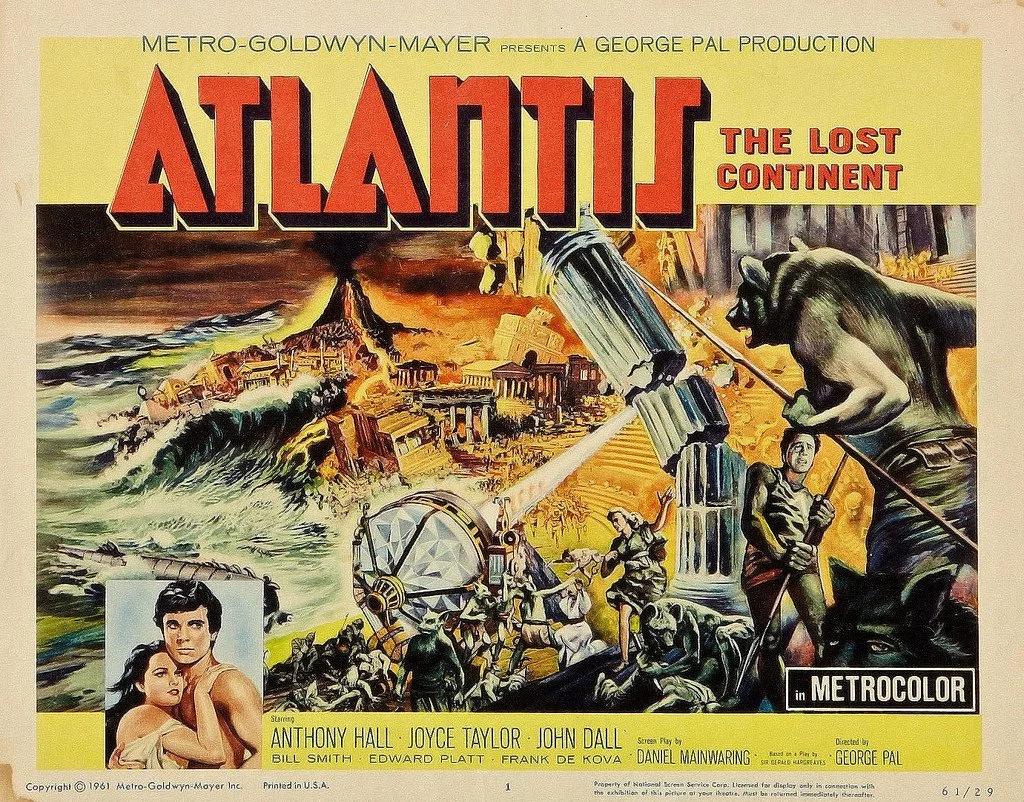
The Atlanteans of the War Party faction refer to themselves as “the Super Race” in a Nazi allegory so transparent you would expect it from the modern entertainment industry. This is the subject of one of Atalanta’s 30 songs. A prophet by the name of Na (NoAh?) warns that the doom of Atlantis is nigh. I should point out that a similarly-named prophet Nodah figures into Francis Ashton’s 1943 Atlantean novel, The Breaking of the Seals. Hmmm. Finally, Atlantis sinks . . . off-stage. We are told by a surviving Atlantean, “Nothing but mud remains.”

The play is dedicated to Sir Winston Churchill, to whom a copy was given. Churchill’s opinion of the gift remains, so far as I am aware, unrecorded. It has never been performed on stage, to my knowledge.
Perhaps Hargreaves realized that such a vision was better suited for the medium of cinema, because in the years that followed, he began shopping around a synopsis for a film adaptation. At some point, the Hargreaves script for the stage version crossed the desk of George Pal. Pal received a copy inscribed to him and must have seen something in it. First he tried to interest Paramount in the project, with no success, and then MGM, with the same results.
The massive unexpected success of the first two Italian Hercules movies at the international box office created a demand for tales of swords and sandals. MGM finally agreed to do it on the condition that the budget be kept low and the film be shot quickly, before the peplum craze burned itself out. Pal agreed to these conditions, helping to seal the movie’s fate before it even began.
In an interview included in Jeff Rovin’s 1977 The Fabulous Fantasy Films, Pal explained the central issue:
“The problem was in the writing. We weren’t ready to go with the picture because we had a poor script. But it was scheduled to shoot, a writer’s strike broke out, and we couldn’t get anyone to rewrite it. We had a very pedestrian script, but the studio told me not to worry. ‘You’ll pull it out with the special effects,’ they said, which we did. But the story and dialogue were horrible.”
How little things have changed, huh?
The movie begins with a cool five-minute animated prologue narrated by Paul Frees. Listen closely to the supporting cast because Frees also dubs 3 other characters in the course of the movie. The prologue has the kind of list of alleged “proofs” of the existence of Atlantis one typically finds in “unexplained mysteries” style literature of the '60s-'70s, similarities between Egyptian and Mayan pyramids, legends of a universal deluge, that sort of thing. Bad history aside, the prologue is quite charming and earns the movie some goodwill which is quickly squandered. For better or worse, little of Atalanta survives the translation to screen, beyond the bare bones of an Atlantean princess getting shipwrecked (Antillia here instead of Atalanta, played by actress Joyce Taylor). She is found by Greek fisherman Demetrios (a very forgettable Anthony Hall, who makes no impression whatsoever). While we’re talking about the cast, later in the film, look for a young William Smith, two decades before he became father to Conan in 1982’s Conan the Barbarian, as the Captain of the Guard. If you know your Robert E. Howard, then you know how fitting it is for a Cimmerian to have an Atlantean for an ancestor.
Pal was quite correct about the script and even in the first half hour it abounds with howlers. There is Princess Antillia’s famous declaration of contempt, “You smell of fish!” Also, “Where is this miserable hovel and why do I wear the garb of slaves?” Later, Demetrios tells Antillia: “In our land, we have no kings, no king’s daughters, no slaves,” a sentiment which would have come as a shock to any actual Ancient Greeks. We never learn why Antillia was even taking an oceanic voyage to begin with, one of the numerous narrative gaps.
Romance blossoms between the young couple as they journey into the unknown. The “romance” is one of the more unbelievable parts of Atlantis, and that’s saying something in a movie with death-rays and beast-men. Antillia is unlikeable in the extreme and Demetrios is a big block of wood. Then there’s the baffling vision/dream/hallucination(?) of Neptune that briefly appears as Demetrius and Antllia sail beyond the Pillars. The god of the sea is painted blue—and judging by the quality, not even waterproof paint—and possesses a noticeable gut. With all the footage which ended up on the cutting room floor, why keep this? He serves absolutely no narrative function and looks terrible. Ray Harryhausen delivered a more convincing sea god just a couple of years later in Jason and the Argonauts.
On the other hand, not long after this we get one of the best parts, when Demetrios encounters a “sea monster” which proves to be an Atlantean steampunk (bronzepunk?) submarine. The model work for the submarine and its arrival in Atlantis hold up well and are the best part of the movie. However the submarine is one of the many intriguing things that the film briefly dangles in front of the audience before seemingly forgetting about them and lurching on.
Budget cuts meant that the production design raided the prop and costume warehouse for anything from the ancient world, with costumes from several other movies including Kismet and Ben-Hur. Monty Python had the Ministry of Silly Walks: Atlantis ruled by the Ministry of Silly Hats. The wild headgear on display is one of the movie's unintentional pleasures. Prop-spotters will have a field day identifying things from Forbidden Planet, The Prodigal and other movies. Antillia makes the acquaintance of the only significant Atlantean character who isn’t a complete and utter jerk: Azor (played by Edward Platt). Azor states that he believes in “the one true God”. He also says that Atlantis lost its way when it, “Fashioned gods in the image of her scientific achievements.” So now, in addition to being a mythology movie and a historical movie and a science-fiction movie, Atlantis is now a sort of sideways Bible epic.
This streak of religiosity has its roots in the original play, which includes a scene lifted straight from the Book of Daniel, with mysterious writing appearing on a wall which is then interpreted by Na. Oddly, the Atlanteans are not overly concerned that the head of their religion is spouting heresies, at least in any of the surviving footage. According to Justin Humpreys in his book George Pal: Man of Tomorrow (which I highly recommend if you can track it down), Pal was not overly religious himself, yet there are a number of overt religious elements in the movies he produced. Most famous of these is the ending to his 1953 version of The War of the Worlds, with the survivors of Los Angeles gathering in a church to await the end, only to witness the Martians succumb to Earthly bacteria, the salvation of mankind heralded by ringing church bells. So this is in line with Pal’s other work. But whether because of the half-baked script or the massive cuts, this is yet another plot element that contributes little and goes nowhere.
A side note on names. “Azor” and “Antillia” are interesting if you know your Atlantean lore. They do not hail from Hargreaves. The Azore Islands, located in the Atlantic, are frequently mentioned in nonfiction about Atlantis as possible remnants of the continent. Antillia (sometimes “Antilia”) was a phantom island which often appeared on Portuguese and Spanish charts during the Age of Exploration. The Greater and Lesser Antilles were later named for them. Atlanteologists have suggested a linguistic connection between the name and that of Atlantis. Clark Ashton Smith, in some of his Poseidonis stories, makes passing references to Antillia. It was also the setting of one of Lin Carter’s stories in Lost Worlds. The choice cannot be coincidental.
When is this film set? We’re told Atlantis is the source of ancient civilizations, but the Greeks are already around. Also, the Greeks call the entrance to the Mediterranean “the Pillars of Hercules” so this is after the legends of Hercules which are supposed to have originated in the Bronze Age. It’s hard to fit Pal’s Atlantis in with real history and it struggles to establish a coherent fantasy setting. Even granting the idea that Atlantis was the origin of all cultures, it’s hard to envision a society where the ordinary citizens dress like Romans while their soldiers go around looking like Mongols while worshipping Phoenician deities. None of it connects. The production designers try, using the repeated stylized “A” emblem to tie everything together. It doesn’t work but at least someone was making the attempt.
There are also a number of scenes where inserts of footage from this movie has been matted into stock from other, more expensive costume epics like Quo Vadis and The Last Days of Pompei. Sometimes this works reasonably well, other times it makes the mismatch glaringly apparent. And it’s a constant reminder that the film’s ambitions far outstrip its resources.
Demetrios gets sent to the mines as a slave, where he witnesses slaves being turned into beast-men in the “House of Fear”. Which is legally distinct from the House of Pain in H. G. Wells’ The Island of Dr. Moreau. Some of them have hands left over from the Morlocks in The Time Machine, as if there wasn’t enough borrowing from Wells. While all this might seem like sheer creative laziness, there’s more to it than you might realize, as we shall shortly see. Of note is the poor unfortunate who already has the ears and horns of a bull, being referred to in dialogue as being transformed into a boar.
After this, Demetrios wins his freedom in the Ordeal of Fire and Water. The Ordeal was hyped in the advertising: “Once seen—never forgotten” but I’ve seen this movie twice and it’s not that memorable. It doesn’t help that it takes place in a tiny triangular pit matted into some stock footage of a Roman arena from another movie. The stock crowd goes wild at the spectacle, but it’s doubtful most of them would be able to see it. We learn that the Atlanteans discovered crystals that harness solar power and turned them into weapons. The slaves in the mines—apparently through the power of deleted scenes—suddenly know that they can hasten the seismic activity which is threatening the continent. The rulers of Atlantis display their resolve to conquer the world (and why haven’t they already?) is signified by them drawing their daggers and stabbing the table like comic book supervillains, in one of the film’s many unintentionally hysterical bits.
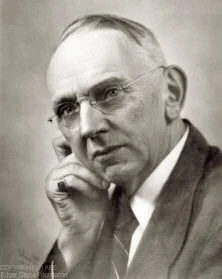
You may notice that there’s a great deal of stuff here that doesn’t originate in the source material. So where did it come from? The answer is Edgar Cayce. To shorten a long story, Cayce was a clairvoyant from Kentucky who allegedly had the power to diagnose illness while in trance and did a number of “readings” where he propounded on the history of Atlantis. The Theosophy-flavored Atlantis of Cayce was the setting for a struggle between the followers of the good Law of One and the evil Sons of Belial. A few of his statements on Atlantis are relevant this movie:
“In Atlantean land in the time of withdrawing from the Law of One—establishment of Sons of Belial—was a priestess in temple built in opposition to the Sons of the Law of One—during time when there was the creating of the high influence of radial activity from the rays of the sun that were turned on crystals in the pits that made connections with the internal influences of the earth.”
“In Atlantean land during those periods when there were the destruction or separations of the land during the period of the first destruction—among those who aided in the preparation of the explosives or those things that set in motion the fires of the inner portions of the earth that were turned into destructive forces.”
And also a reference to slaves the Atlanteans made, “those laborers that were considered by many as merely things rather than individual souls.”
Here we have no less than four plot points from Cayce’s Atlantis: Atlanteans turning away from good to evil, harnessing the power of the sun with crystals, creating half-human slaves and turning the science of Atlantis towards the destruction of their own land. Either Daniel Mainwaring or Pal or perhaps even both were familiar with Cayce and cribbed a few details. Like so much in this movie, the beast-men briefly strut and fret their hour upon the soundstage—signifying nothing. I suppose they illustrate how evil the Atlanteans are, but the film has already hammered the audience with that point, with various Atlantean baddies laughing evilly at the misfortunes of Demetrios and others.
In addition to the scripting woes, some 30 minutes of footage were cut, resulting in a number of plot holes. One of the casualties were the “Flying Men”, guys using DaVinci-esque ornithopter rigs who make a few appearances through the original version of the movie, including at the climax when they would have been used in an ill-fated attempt to escape the sinking continent. Test audiences found them unconvincing and out they went, appearing only as sketches in Azor’s laboratory. One of the other casualties was a scene involving the Flying Men and the submarine, which resulted in the loss of some of that vehicle’s screentime.
The movie saves one of its silliest moments for last, when Zaren is zapped by his own crystal death-ray and his flesh dissolves, leaving behind a full-articulated wired skeleton complete with a flip-top skull. And why does Zaren leave a skeleton anyhow? Everybody else killed by the ray just vaporizes. This goofiness was completely avoidable. Instead we get a moment straight out of an Ed Wood movie. That said, the actual model work for the cataclysm is pretty good. Good enough, in fact, to have been swiped for a pair of future productions: Luigi Cozzi’s gonzo 1983 Hercules, and a third season episode of Hercules: The Legendary Journeys.
Paul Frees returns to inform us that the escaping slaves carried with them the knowledge of Atlantis to the four corners of the Earth (quite literally, because one of the animated ships is shown heading towards the Arctic). But wait: these were slaves. What did they know about Atlantean science? What could they possibly hope to reconstruct? Would they even want to, considering it was used to kill and mutate them? Anyhow, movie’s over. In spite of all the cost-cutting, the movie still ran over-budget, almost twice the cost of The Time Machine, and lost money at the box office amidst poor reviews. Anthony Hall never headlined another film.
It’s fun to imagine some other reality where Pal got his chance to make a better Atlantis movie, perhaps based on Cutcliff-Hyne’s The Lost Continent. Of course, you would have needed the services of Ray Harryhausen to create stop-motion animation for the mammoths and sabertooths and plesiosaurs. Assuming a healthy production schedule and no strike, we could have had a movie worthy of the Pal name.
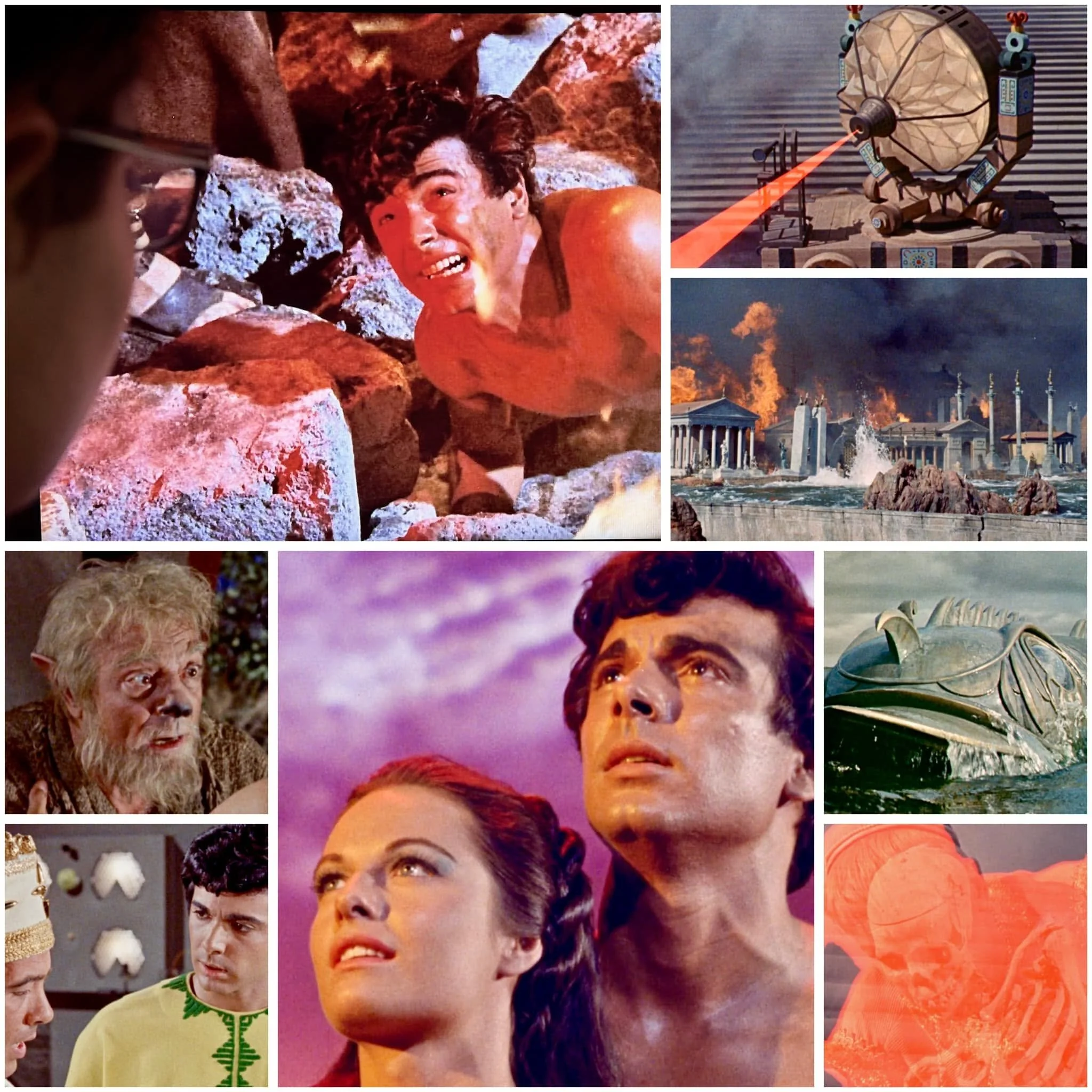
Atlantis, the Lost Continent is worth watching at least once so one can marvel at the model work, the absurd dialogue and mourn the squandered potential. I would like to say that this is Pal’s most disappointing film, but 1975’s Doc Savage: The Man of Bronze was yet to come. Yet it remains a fascinating artifact, a rare attempt to show Atlantis at the peak of its civilization, and for that, at least, it deserves some credit for its unrealized ambitions.
What might have been!