
The Battle of Hastings, 1066: The Echoes Still Reverberate After Almost 1,000 Years
Some dates reverberate through the ages. For an example, July 4, 1776. A bit more than seven hundred years before that date, the destiny of Europe—and by extension, the entire world—turned on the outcome of one battle on an island of middling size off the coast of the Eurasian landmass. That battle is now referred to as the Battle of Hastings. It took place on October 14, 1066. Hastings was, to borrow a phrase from Churchill—a descendant of combatants on both sides—a “hinge of fate”.
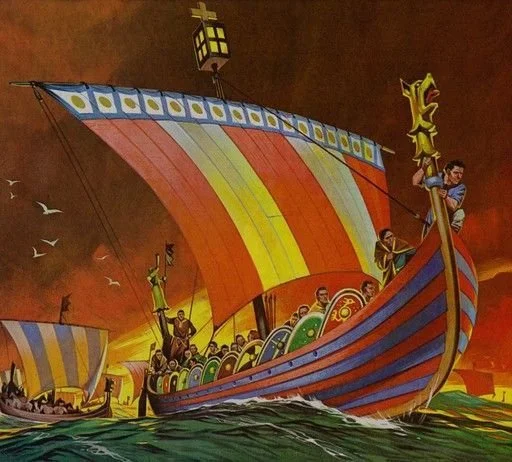
Angus McBride’s rendition of Duke William the Bastard’s flagship, Mora, on its way to Hastings.
I first became vaguely aware of the Battle of Hastings at some point before I became a teenager. I do know the moment when it went from being a factoid to becoming a minor obsession for over a decade. That would be when I bought the Bantam edition of The Road of Azrael. Harold Godwinson, the last, doomed king of Anglo-Saxon England, makes an appearance in that Robert E. Howard yarn. Harold was the man who confronted Duke William the Bastard of Normandy at Hastings.
I have called the Battle of Clontarf the "Bloody Superbowl of the Late Dark Ages". Hastings--combined with the Battle of Stamford Bridge--could easily be called "The Bloody Dawn of the High Middle Ages". Between the two battles, you had two kings and a future king involved. The combatants who fought in those battles hailed from all over western Europe. At its core, the Battle of Hastings was a closed-cage match between the heavy infantry that had dominated Western European battlefields for a millennium and the resurgent, aristocratic, horse-based model that would rule for the next five hundred years.
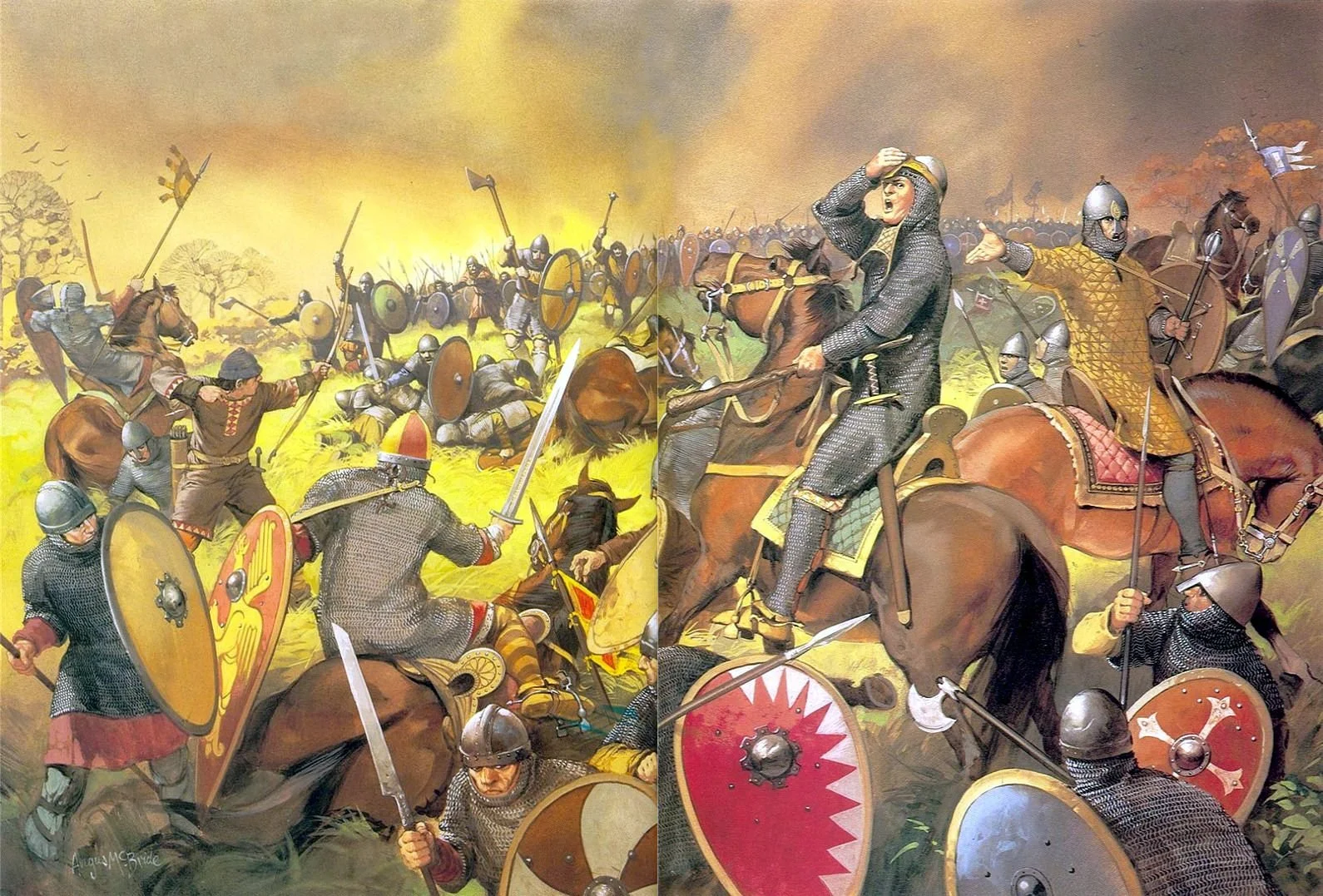
Duke William at the Battle of Hastings, sporting his trademark war-club. Art by Angus McBride.
Hastings and everything leading up to it was fraught with outstanding dramatis personae. Not just Harold and William, but also the mighty King Harald Hardrada. Harold's nutjob brother, Tostig Godwinson, convinced Hardrada that the English throne was up for grabs. Hell, even Pope Alexander II--the only Norman pope, ever--got in on the action. Looking into the Battle of Hastings is like peeling layers of an onion. Sure, the main players are great, but even the second- and third-tier people involved are fascinating. On top of everything else, Halley’s Comet hung over Europe that year, foretelling doomful events. Shakespeare should've written a play about it.
The inherent drama was over the top. Harold’s father, Godwin, had been high in the counsels of King Canute. Duke William, endorsed by the feckless Edward the Confessor, had risen from a childhood as the hunted heir of Normandy to the second-most powerful man in France. He had extracted—some would say ‘forced’ or ‘tricked’—an oath of allegiance from Harold a few years earlier. Harald Hardrada, the would-be conqueror of Sweden and Denmark, had been waging war against Harold’s cousin—King Svein Estridsson—for almost two decades. The destinies of all three intertwined in myriad ways. Only one would survive.
For anyone who wants a short, well-written book on the whole shebang, 1066: The Year of the Conquest by David Howarth still takes the crown. Howarth was an excellent historian and I recommend all of his books.
The Battle of Hastings and its antecedent events have inspired well over a hundred novels since the 1800s. I can't claim encyclopaedic knowledge of them, but I've read more than my fair share.
Henry Treece, an author I've called "the English Robert E. Howard"--Michael Moorcock and John Maddox Roberts have also expressed their admiration for Treece in the past--wrote three books in which Hastings and the Battle of Stamford Bridge appear. Those would be Hounds of the King, The Last of the Vikings and Man With a Sword.
Poul Anderson's excellent 'The Last Viking' trilogy about Harald Hardrada ends, of course, at the Battle of Stamford Bridge. The Sign of the Raven recounts that battle in Poul's inimitable style.
I found Harold: The Last Anglo-Saxon King by Ian W. Walker a pretty solid read. I can say the same for Laurence J. Brown's Housecarl.
For fans of Morgan Llywelyn, I would recommend The Wind from Hastings.
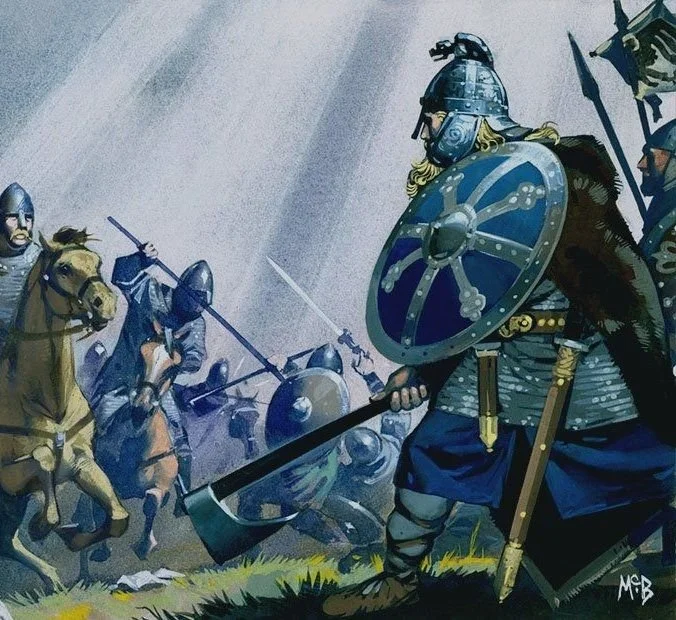
English housecarles versus Norman knights. Art by Angus McBride.
The Battle of Hastings reset the entire chessboard of Western Europe. England became a major player in Continental politics, with consequences that echoed through the Hundred Years' War and far beyond. Scandinavia became something of a backwater--until the days of the mighty Gustavus Adolphus. Nearer to home, the rise of the Normans--the most formidable ethnic group in Western Europe--had profound effects upon Scotland, Ireland and Wales. In turn, all of that, ultimately, affected England's empire in North America and the Founding Fathers of the United States of America.
For myself, I raise a glass to the shade of Harold Godwinson. I think Robert E. Howard would as well.