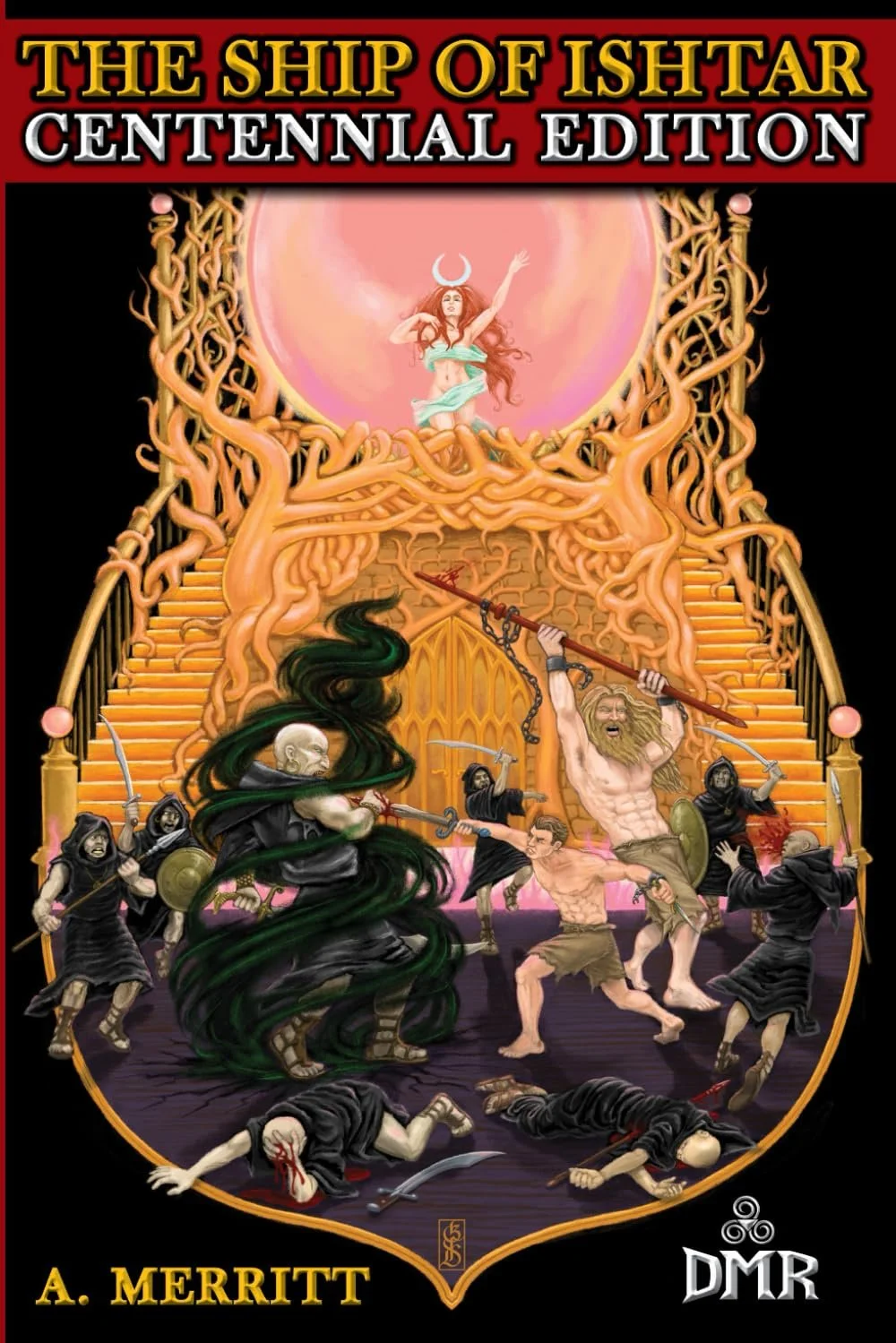
Of Ships and Merritt and Moorcock
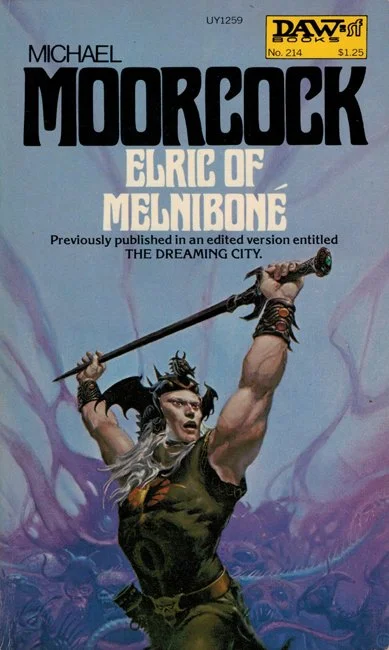
Today marks the birthday of A. Merritt. This year also marks my fiftieth anniversary of first reading Michael Moorcock’s Elric in prose. Thus and so, today seems a good day to look at the influence of Merritt’s The Ship of Ishtar upon two of Moorcock’s Elric novels.
First off, some might ask, "Deuce, how do you know that Moorcock even read The Ship of Ishtar?". Well, open up your copy of Fantasy: The 100 Best Books by Moorcock and James Cawthorn and look at #81. Not only did Mr. Moorcock read The Ship of Ishtar, he ranked it as one of the great fantasy novels.
With that out of the way, let's look at Elric of Melniboné, Michael's 1975 Elric novel. In that novel, Elric seeks to pursue his hated cousin, Yrkoon, who has abducted and fled away with Elric's beloved, Cymoril. In order to catch up with Yrkoon, Elric needs the Ship Which Sails Over Land and Sea. Straasha, Lord of the Sea, gives it to Elric. However, there is a problem, as the Michael Moorcock's Multiverse website points out:
“The Ship Which Sails Over Land and Sea is a magical ship that was built by Straasha and Grome working together, the ownership of which has been a point of contention between them ever since.”
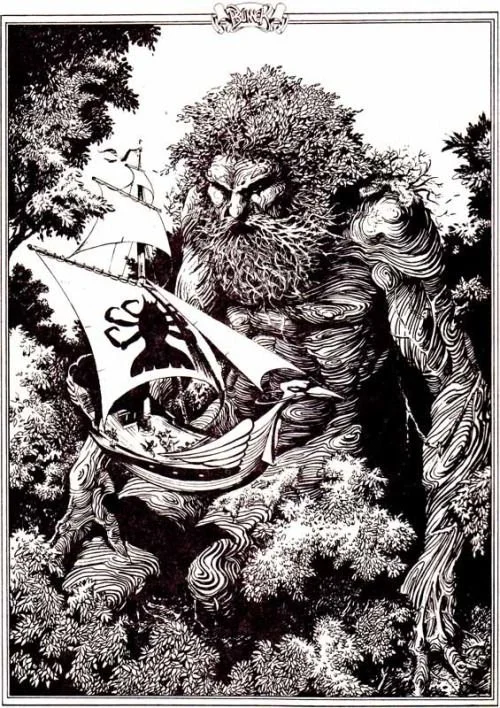
Lord Grome takes back ‘his’ ship. Art by Frank Brunner.
A magical ship contended over by antithetical deities, you say? Straasha is a sea-god while Grome is an earth-god. Now, compare that to Merritt's 'Ship'. While called 'The Ship of Ishtar', when John Kenton first climbs aboard--and for long after--the Ship is hotly contested between two factions. The stern of the Ship is controlled by priests of Nergal, the god of death. The bow of the Ship is ruled by the priestesses of Ishtar, the goddess of love and war. The Ship was created as a floating battlefield upon the deck of which the two deities would wage an age-old feud. A literal line divides the two halves of the Ship; the bow-half is white, the stern-half is black.
So, two ships created through grudging cooperation between two antithetical deities. How often had that concept been used before Elric of Melniboné? Just once, by one Abraham Grace Merritt. Obviously, Mr. Moorcock did something quite different with his 'Ship' concept. If nothing else, Moorcock's career has shown he has a talent for taking tropes and putting his original spin upon them. The fact remains that Merritt did it first.
But wait, there's more...
In the second Elric novel--in the classic DAW Books series which truly launched the Melnibonean upon the American fantasy scene--that is, The Sailor on the Seas of Fate, we once again see the influence of The Ship of Ishtar.
In 'Sailor', Elric boards 'The Dark Ship', an eldritch, uncanny barque which plies an interdimensional ocean. Its passengers hail from various dimensions and timelines. In the case of 'Sailor', it brings together several Eternal Champions 'fated' to combat a cosmic evil. The Dark Ship is crewed by a Blind Captain and a Mute Steersman. It seems destined to always sail the Seas of Fate, a Sword-and-Sorcery Flying Dutchman.
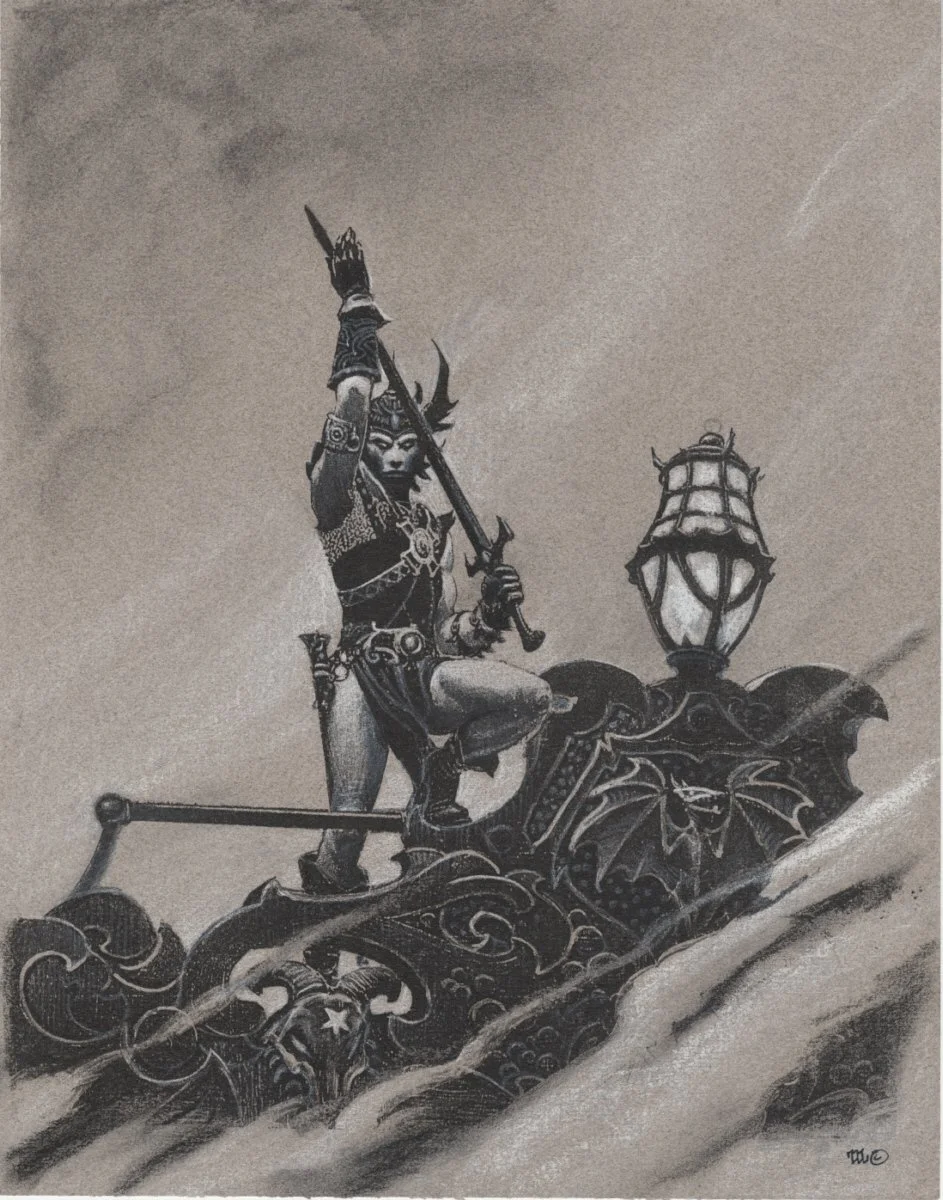
Prelim sketch from Michael Whelan for The Sailor on the Seas of Fate.
Similarly, the Ship of Ishtar sails the crystal seas of a pocket dimension, the 'World of the Ship'. The ship puts in at various ports to take on water and supplies. The most significant port is Emakhtila, which is thronged by disparate peoples from various ages and epochs. It should be noted that the galley-slaves of the Ship hail from a similarly wide swathe of eras, ranging from at least the third century A.D. to the twentieth century.
The Ship is fated to sail and sail and sail until the feud between Nergal and Ishtar is finally settled. When John Kenton arrives upon the scene, the Ship has been coursing across the seas of the World of the Ship--in real world terms--for over four thousand years.
Once again, we have two ships fated to sail an eldritch sea--perhaps--for eternity. Once again, Moorcock came up with his own unique take on the concept, but Merritt originated the idea, make no mistake.
That's the thing... Like most of the truly great SFF writers, Merritt created concepts which inspired future generations of authors. Poe, Haggard, Dunsany, Burroughs, Merritt, Lovecraft--their concepts were taken in many, many different directions by the authors that followed. Those same literary titans are still there to be read, fountainheads of unmatched imagination to inspire new generations.
If all of this makes you curious to read Merritt's The Ship of Ishtar, look no further than DMR Books. DMR has published the definitive version in cooperation with the A. Merritt estate. It can be found here.
So, raise a glass for two men of literary genius, sword-brothers! Both created their own immortal brands of exotic adventure that still thrill readers like you and me. Crom grant they do so for many years to come.