
Robert E. Howard and the Fate of Empires
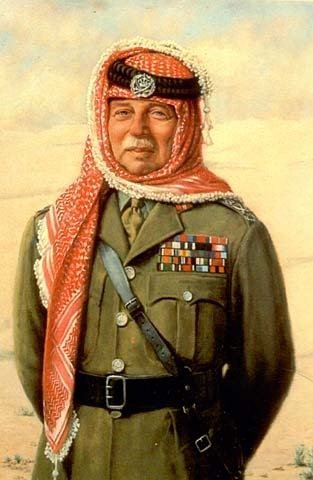
John Glubb, as commander of the Arab Legion.
A few years ago I read a book called The Fate of Empires and Search for Survival by the military historian, John Glubb. In it, he analyzed the history of eleven different empires and found many similarities in their trajectories.
Interestingly, this book reminded me of Robert E. Howard. Why? Well...
John Bagot Glubb was born in 1897; his father was an officer in the British Army. Glubb entered the Royal Military Academy in Woolwich in September 1914, and joined the Royal Engineers in April 1915. Later, in 1926, he accepted an administrative post in the nascent Iraqi government.
In 1930 he signed a contract to serve as part of the Transjordanian Government (now Jordan), and from 1939 to 1956 he commanded the Jordanian Arab Legion, which was actually the Jordanian army itself. He transformed this local force into the most efficient Arab army in the region. Later, he resigned when Jordan became independent from England and, upon retirement, published seventeen books, mostly about the Middle East, and gave numerous lectures in England, the USA, and Europe, passing away in 1986 in Mayfield, England. A very intelligent and formidable man. Some military historians have even called him “The Other Lawrence of Arabia.”
In one lengthy essay, John Glubb concluded that all Empires—all of them—regardless of their military technology, religion, values, communications, or means of transport—go through six phases:
1) Eruption: a people on the fringes of an old Empire, usually starving, with few weapons or resources, suddenly emerge and conquer the former Empire. This people is marked by its entrepreneurship, willpower, toughness, and, above all, aggressiveness. Because they are not limited by any formal education, rules, or traditions, they are always willing to improvise to reach their ultimate goal: victory over the old empire.
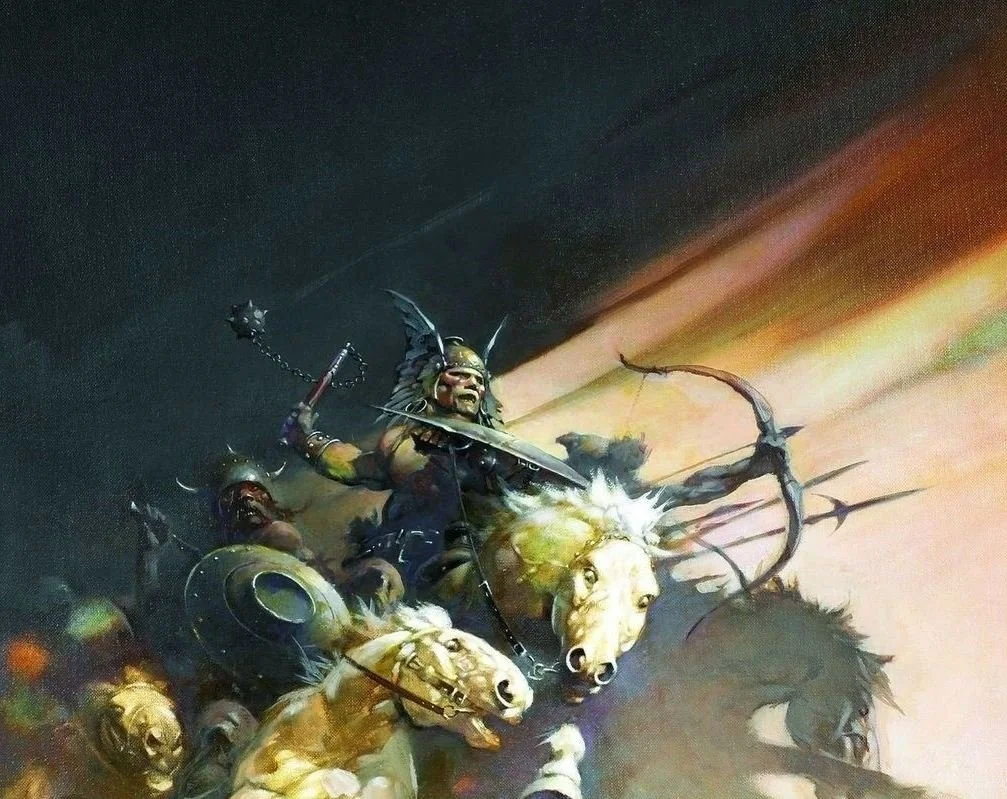
Art by Frank Frazetta.
2) Age of Conquests: After adopting the resources of the old empire (be they technologies or material resources), the new Empire expands, conquering more and more territories. There seems to be no limit to its conquests and victories. They themselves feel superior to other peoples, believing that their success is something divine or inherent to them. The education of young people is extremely harsh, aimed at transforming all boys into future warriors for the nation—or, as we would say today, forcing everyone, if not in spirit, at least in physical capacity, to become "alpha males".
3) Age of Commerce: Now the Empire is solidified. Little by little, the focus of the younger generation shifts from "honor and glory" to "gold and profit". Much of the founders' initial energy to protect the Empire from any other people who decide to rise up still exists, but it is noticeable that education and objectives have shifted from "serving the Nation" to "serving my own pocket". Initiative and entrepreneurship cease to be warlike and become mercantile.
4) Era of Abundance: This phase represents the peak of this society. The world's riches seem to flow to them without the slightest effort. The wealthiest find themselves with a problem: what to do with so much money? It is here that, in fact, a change in the mentality of these people begins to occur:
– education ceases to be as demanding as it was. The aim is to train bureaucrats, merchants, and executives for the most lucrative positions, no longer soldiers or warriors.
– since there is more money than courage, they seek to buy their enemies instead of fighting against them. This era can be marked by the entry of subjugated peoples as soldiers of the Empire.
– the use of war to defend the nation is considered "immoral and primitive"; "it's not that we are afraid to fight, but rather, we are too civilized to fight" is the dominant thought.
– Immigrants from all over the Empire flock to its largest cities, in search of wealth and a better life, in a way 'diluting' the original mentality that formed the empire.
Glubb tells us that, however loyal these immigrants may be to the Empire, they will never be so willing to put their lives and wealth on the line to defend it. Not to mention that their presence ends up influencing the decisions of the empire's leaders.
A "monument" that marks this era is the Wall—to prevent attacks by barbarians, or, as it is currently, the entry of illegal foreigners. The nation went from attack to defense, becoming passive.
5) The Age of Intellectualism – The Beginning of the End
“The barons of industry and commerce seek fame and admiration, not only by becoming patrons of works of art, music, or literature. They also found and donate money to colleges and universities. (...) The ambition of young people, previously dedicated to obtaining adventure and military glory, and which later turned to the accumulation of wealth, now turns to the acquisition of academic honors.”
It is assumed that intellect can solve all problems—however, when the time comes to act, the Empire’s various parties and ideologies are so embroiled in endless debates that nothing gets done. From the outside, the Empire appears to be living in a Golden Age—but inside, it is rotten.
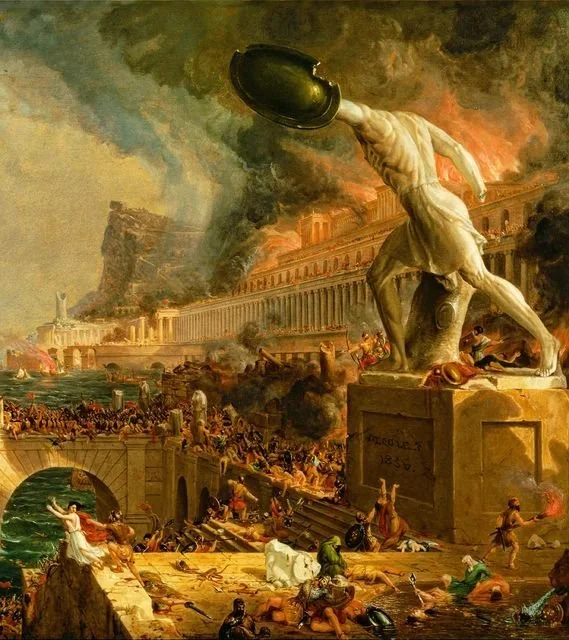
6) Era of Decadence: The Empire, when it is ready to fall, is marked by:
– Pessimism
– Materialism
– Frivolity: the idol of the masses is no longer the general, the hero, or the saint: it is the musician, the actor, or the athlete.
– Relaxation of customs and loss of morals: a more vulgar language and behavior, usually disseminated by the "pop" singers of each era, becomes common among the people.
– The creation of a welfare state
– Generosity towards all peoples (distribution of citizenship, creation of universities and public hospitals throughout the Empire, etc.)
– The emergence of some form of feminism
In this phase, it is only a matter of time before some new race emerges and seizes the riches, territory, and culture of the old Empire.
It is worth quoting Glubb's analysis of the Decline phase of the Arab Empire, eleven centuries ago:
“In the first half of the 9th century, Baghdad enjoyed its apogee as the largest and richest city in the world. (…) The works of historians from that time are still available. They deeply deplored the degeneration of the times in which they lived, mainly emphasizing indifference towards religion, increasing materialism, and laxity of morals. They also lamented the corruption of government officials, and the fact that politicians always seemed to accumulate great fortunes when in power.
They commented bitterly on the extraordinary influence that popular singers had on the masses, especially the younger ones, which led to a moral decline. The ‘pop’ singers of Baghdad at that time accompanied their erotic songs with the lute, an instrument reminiscent of the modern guitar. In the second half of the 10th century, as a result, much sexual and obscene language became common, such that it would not have been tolerated in the past. Many caliphs signed orders banning these ‘pop’ singers, but a few years later they returned.
An increase in the influence of women in public affairs is also associated with the decline of the nation. (…) In the 10th century, a similar trend was observed in the Arab Empire, with women demanding admission to professions previously reserved only for men. Ibn Bessam, one of the historians of that time, wrote: “What do the professions of clerk, tax collector or preacher have to do with women? Such occupations have always been limited to men.” Many women studied law, while others obtained positions as university professors.
Soon after this period, the government and public order collapsed, and foreign invaders took over the country. The increase in violence and confusion made it dangerous for women to walk unaccompanied in the street, which led to the collapse of this movement."
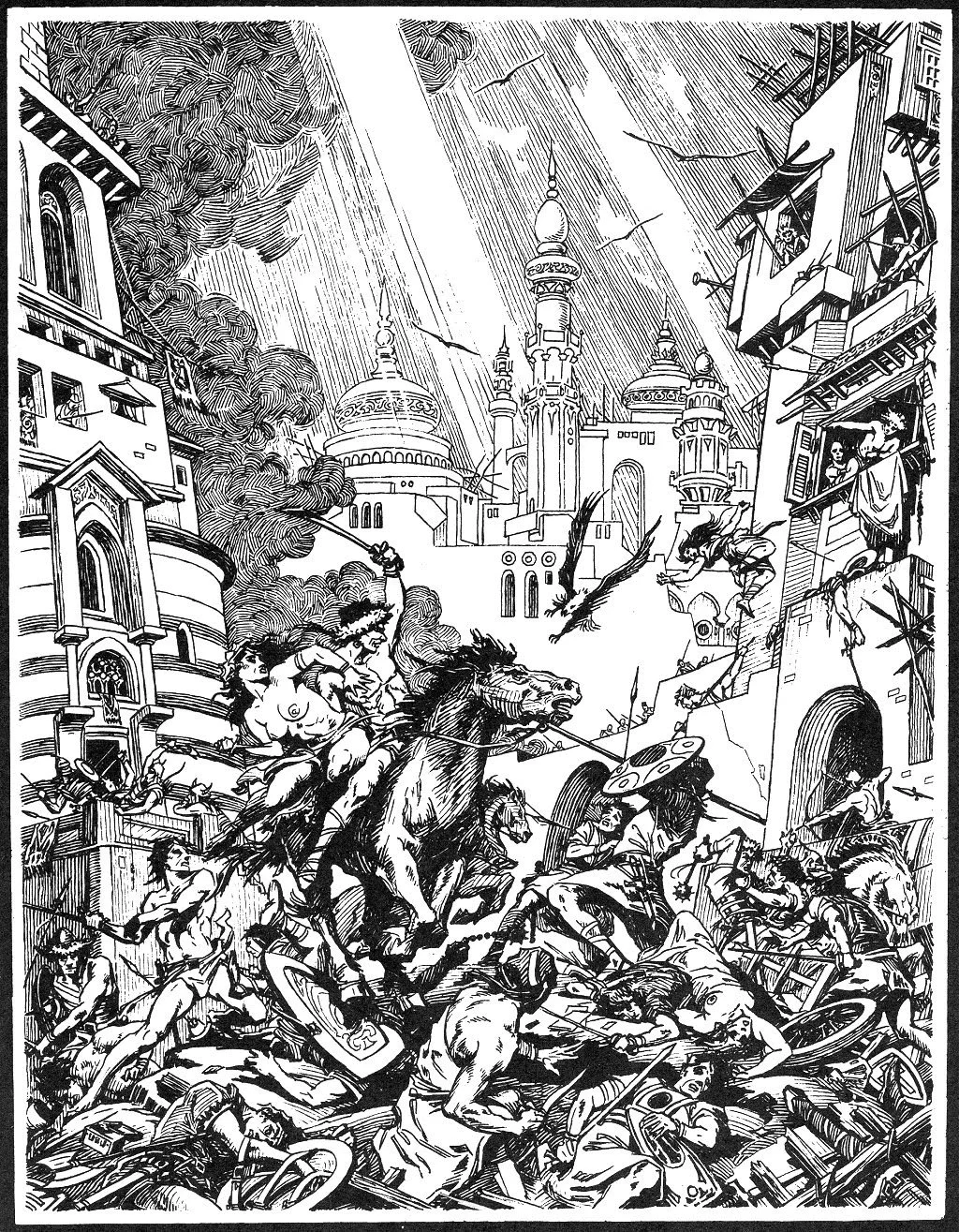
Art by Roy G. Krenkel.
John Glubb calculated the life cycle of empires at roughly ten generations or two hundred fifty years, while admitting that the span of empires varies immensely, depending on the external forces surrounding them.
Some empires continued to exist after the end of their life cycle, but in an almost permanent state of civil war, like the Eastern Roman Empire, and others simply changed hands, like the Mamluk Empire of Egypt.
What does this have to do with Robert E. Howard? The Fate of Empires was published over four decades after his death. However, he was a man of immense intellect and insight. Even as a teenager, Howard discerned the cyclical nature of empires and their decadence, as he said in a letter to Tevis Clyde Smith:
"When a nation forgets her skill in war, when her religion becomes a mockery, when the whole nation becomes a nation of money-grabbers, then the wild tribes, the barbarians drive in.
England had her Norsemen, her Scots, her Normans. Israel had her Philistines, her Ammonites, Assyrians, her Babylonians.
Egypt had her Hyksos, her Ethiopians.
France had her Prussians.
Persia had her Greeks, her Parthians.
Russia had her Japan.
Spain had her Moors, her England.
Who will our invaders be? From whence will they come? Where but from Asia? Can a nation ally the Tartars, the Mongols, the Indians; the tribes of Asia? Buddhist, Bonist, Brahmin, Erlikist, Mohammedan? Unite them and hurl their united strength against the rest of the world? Such a nation would rule the world."
-- Letter to Tevis Clyde Smith, 30th July, 1923
And what of these stanzas from "A Word from the Outer Dark", written a just few years later?

"For I would hurl your cities down
And I would break your shrines
And give the site of every town
To thistles and to vines. (...)
For all the works of cultured man
Must fare and fade and fall
I am the Dark Barbarian
That towers over all."
Robert E. Howard knew that our civilization is not unique, that there are patterns which mark the rise and fall of empires. For this reason, John Bagot Glubb's analysis reminded me of Howard's own attitudes. As always, dark motives stir the souls of nations. Time and again, the cycle of empire repeats itself, powerful dominions emerging while displacing others. And time and again, they will find their empery merely a handful of gilded dust, thus sowing the seeds of future conflict. When that day comes, many innocents will surely pay the price.