
Barsoom Eternal: H. Beam Piper's Omnilingual
“Barsoom Eternal” is a title I coined for stories written by those SF or fantasy writers who inherited something of ERB’s Mars, be it the landscape, the cultural settings or simply the mood of a vast mysterious Mars. I previously wrote about “A Rose for Ecclesiastes” by Roger Zelazny, as a “Barsoom Eternal” story, also published on the DMR Blog. This piece is about H. Beam Piper’s novella “Omnilingual.”
H. Beam Piper
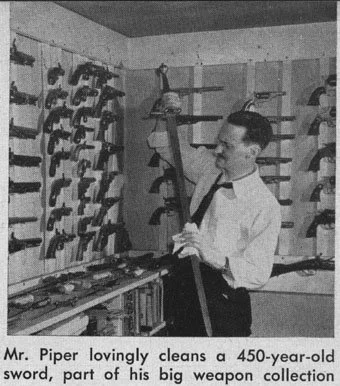
H. Beam Piper was born March 23rd, 1904. Born into poverty, he became a railroad worker, then a guard. Not a train guard, but a security officer patrolling marshalling yards. He then became a Pinkerton agent. Blessed with an acute, perceptive intelligence, Piper read voraciously and taught himself many subjects. He became an expert on firearms, and had an extensive collection of his own. Piper was often enigmatic in public and had a slightly mysterious persona. In his thirties he started writing fiction.
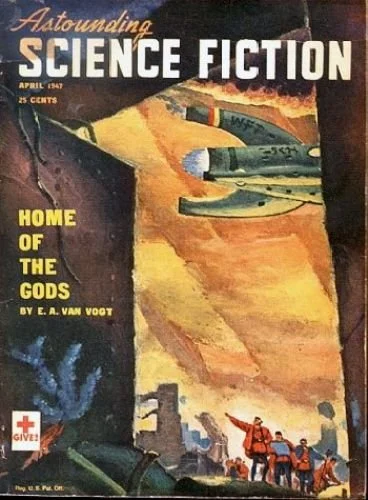
His first SF story “Time and Time Again” was published in 1947, in Astounding Science Fiction. He then began an incredibly prolific career in which he published a vast number of stories and novels. He was a huge favourite at Astounding. His stories were meticulously researched but never dry. Hard facts became the springboard for fast-paced space/alternate Earth action.
Like so many talented early SF/Fantasy writers, he was drawn to the idea of Mars. Initially, he used Mars as a theme, the idea that humanity originated on Mars. This was an underlying theme in several of his early stories, most notably the story “Genesis.”
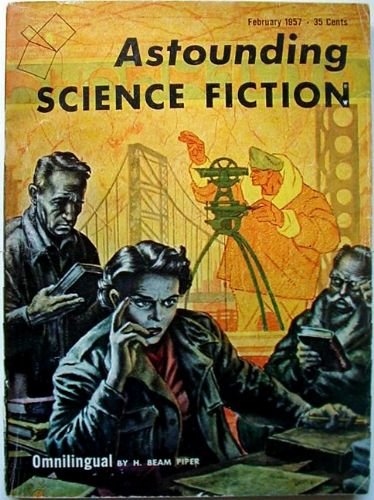
Then in 1957 he wrote “Omnilingual,” different from anything else he had written to that point.
Omnilingual
Omnilingual opens with a pure poetic description:
Martha Dane paused, looking up at the purple-tinged copper sky. The wind had shifted since noon, while she had been inside, and the dust storm that was sweeping the high deserts to the east was now blowing out over Syrtis. The sun, magnified by the haze, was a gorgeous magenta ball, as large as the sun of Terra, at which she could look directly. Tonight, some of that dust would come sifting down from the upper atmosphere to add another film to what had been burying the city for the last fifty thousand years.
We are on Mars, and Mr. Piper has painted a picture both beautiful and compelling. There’s further description of Mars and a physical sense of place which Piper takes the time and trouble to describe for us. Descriptions of places, their atmospheres, their light and darkness, both physical and emotional, are very important to “Omnilingual,” as we shall see as we go along.
Who is “Martha Dane?” What is she doing on Mars?
It’s the end of the day and Martha returns to a temporary building. This is the headquarters of the first Earth archaeological mission to Mars. It is a small expedition, a quartet of profession archaeologists (of which Martha is one), military and space force support teams, and two reporters. They are breaking the ground for a much larger expedition which will leave Earth in a year’s time. Mars is dead, and the main objective of the expedition is to find some clue as to why the Martian race and civilisation died.
Piper’s tone changes and becomes almost casual, the chatty friendliness of colleagues working on a project together. Piper has some of the magical ability of Robert E. Howard, the ability to draw a scene in very few sentences. We quickly learn of the current state of the expedition and of our main characters. Though young, Martha is a very talented and experienced archaeologist and was picked by the lead archaeologist Selim Von Ohlmhurst. Selim is a German of Turkish descent. He is an older man, one of the most famous archaeologists alive, now at the end of his career. The junior archaeologist in the room is Sachiko Koremitsu, a beautiful young Japanese-American woman, who with incredible dexterity, is freeing a tiny fragment of silicon from the detritus of millennia, a minute remnant of one of the long-gone Martian silicon “books.”
Martha and Selim speak and though the conversation is friendly, there is an undercurrent of tension. Martha has devoted herself to trying to translate the Martian language, a task that the rest of the expedition believe to impossible. There is not, and can never be, a “Rosetta Stone” that will allow the translation of Martian symbols into English. Selim is concerned that Martha is wasting the expedition’s time on a wild goose chase.
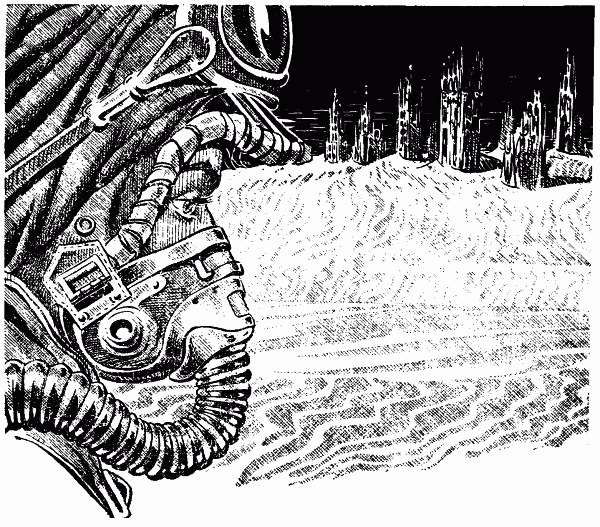
Illustration by Frank Kelly Freas
Several other expedition members return to the room. Chief amongst them is Tony Lattimer, a handsome young archaeologist, who has been doing the fun work, breaking into abandoned buildings with atomic jackhammers and explosives. Wearing tanked oxygen and using the skills of military engineers assigned to the expedition, Lattimer’s crew has been followed closely by the two reporters. Tony is brash, outspoken and ambitious, a man on the make, determined to be the hero of the expedition and a celebrity back on Earth. He openly disparages Martha’s work. Other members arrive and join in the discussion and ironically it’s the leader of the expedition, Space Force colonel Penrose, who defends Martha. Tony doesn’t agree, it’s clear that if he has to make his bones over Martha’s professional corpse, that’s just fine with him. The discussion becomes free-ranging and the expedition members talk about how ancient languages on Earth have been translated.
We learn about many of the main characters now, through show, not tell. It’s clear that though almost everybody admires Martha professionally, they believe her obsession with translating the Martian language is a great mistake. This opening scene shows us who they are but more importantly it reveals Martha to us. She feels the tension, the disapproval, even has her own formidable doubts, but a deep-seated belief remains, that she is doing important work. She tells Sachiko that archaeologists can only make progress by making mistakes.

Illustration by Frank Kelly Freas
So far every building the expedition has broken into has been stripped bare and what was left has collapsed into the red dust of Mars. Selim says when Rome fell, the barbarians that followed stripped Roman buildings of everything valuable, including the stones, because the capacity to make such things had been lost. Selim posits that Mars looks like a gigantic version of the fall of Rome. A once-great culture that fell into barbarism. That those who came after cannibalized their fallen civilisation. Mars is a gigantic mystery which the expedition are striving to solve. The one advantage they have is that Mars is so incredibly dry and arid. Those Martian fragments they have found are preserved because the there is no moisture to aid decay.
Piper perfectly captures the feel of a collegiate yet professional expedition. It is a very Nineteen-Fifties Rand Corporation-style project, measured, hard-working, with the goal of unravelling at least a part of the Martian mystery. The expedition members are literate, perceptive and team-spirited. They gather for cocktails at the end of every work day. I am guessing that at some point in his past Piper was exposed to a Rand Corporation or similar project.
Things happen apace and Piper moves into the tight action-oriented storytelling his fans loved. A military team fly into one of the deep depressions that were once seas. In deep ravines 35,000 feet below the plain on which they are working, they discover oxygen. And life. In a very deep canyon, they find a furry quadruped, about a foot long, with bird-like claws, that lives in burrows in the sand. If you read this and you know Mars has no oxygen, remember Piper was writing in 1957, when scientists still believed there might be breathable atmosphere and life on Mars. The discovery of life moves the focus of the expedition away from the archaeologists to the small military biosciences team. The story itself uses this an opportunity to focus on Martha’s inner monologue.
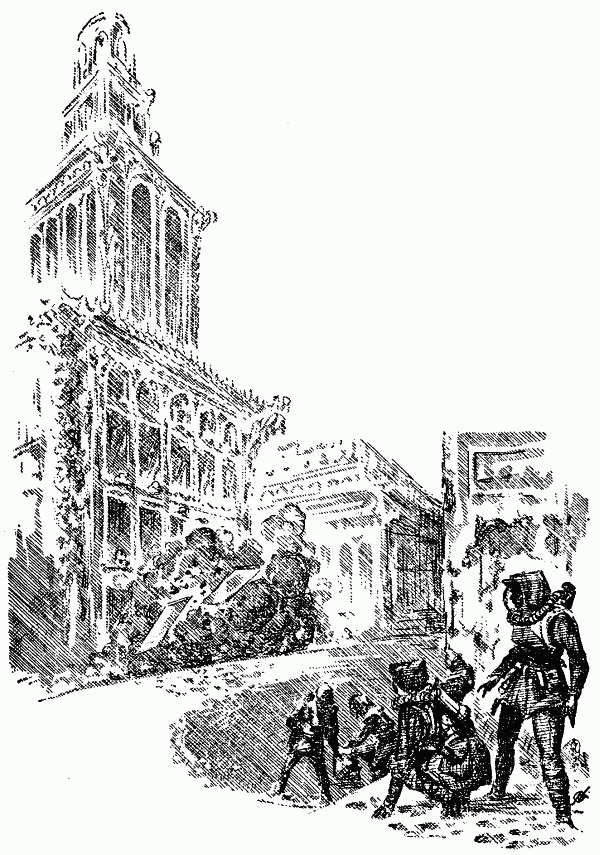
Illustration by Frank Kelly Freas
Several positive events lift everyone’s spirits and the expedition moves into a higher gear. Tony Lattimer and a crew of military engineers select a new building to break into. They have found that breaking into Martian building to be very difficult. Martian materials science was very advanced and some of the structures are almost unbreakable. Because the expedition is so small, everyone, archaeologists, military engineers and medics, even Space Force officers, team up to break into a very large building. All the buildings are buried in ages-thick layers of the red loess. But the building Lattimer chooses is very big and has several floors above ground.
Lattimer blasts open a wall and the team enter the building. They look around and realise their incredible luck. The building has not been stripped! At least some of the Martians made their last stand here.
Mars and Mystery
The tone of the story changes and as we read, the expedition becomes about decisions and action. Carefully, with controlled precision the expedition starts to explore the very large building. Murals on walls show them that the Martians were humanoid. Many of the rooms are evidently classrooms, though the humans cannot read the titles carved over the doors of the rooms. Piper has a direct muscular style here, and following the Earthers around as they explore and find so many pictures, signs, and artefacts, speeds the story along. The expedition’s military engineers seal the building and setup an oxygen atmosphere. Martha works hard, photographing signs and murals, picking and cataloguing findings, basic archaeological work. She has learnt the generic meaning of a single Martian word, by inference, seeing it in context, inscribed on walls in the building. However this small achievement is not enough to still the criticism from Tony Lattimer.
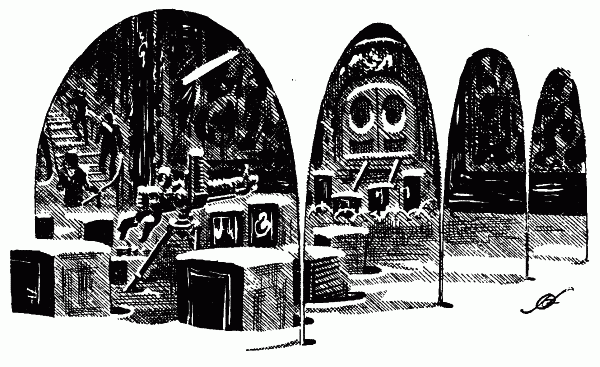
Illustration by Frank Kelly Freas
Piper leads us through a series of discoveries, we are in a detective story now. Like so many buildings, many floors are below the level of the red Martian dust. It becomes apparent that this university building was chosen as a citadel. The team explore the levels below the dust. On the ground level they find both entrance/exits barricaded, windows sealed over. There are the remains of automatic weapons strewn round. This was a last stand. This in itself is a satisfying read, as the pieces of the puzzle come together.
Selim Von Ohlmhurst and Colonel Penrose decide that the building is safe and allow the expedition to move in and choose rooms to inhabit. After the overcrowding and hot-bunking of the temporary building everyone is keen to do so.
Ghosts of Mars
But even with all that the expedition have discovered the mystery deepens. Tony Lattimer discovers the building’s source of electrical power, a wind-rotor in the ceiling of the upper floor, powering a series of armatures. But there are more puzzles than answers. An iron bar is found in a vice, with a saw stuck halfway through, in an abandoned cut. A millennia-old pan on top of a stove, with dust that must once have been food. Desiccated fabrics on beds, which still hold the imprint of a body, only to collapse into dust at the slightest touch. Like the Martians turned to ghosts in a single instant. Murals show a race that had discovered the atom, and there the murals end.
None of it makes sense and a creeping sense of unease begins to overwhelm the team. Piper builds a horrid oppressive atmosphere, as the archaeologists become more paranoid. Selim Von Ohlmhurst develops a strange habit of jerking his head around quickly and peering intently into corners. Sachiko Koremitsu starts carrying her military-issue pistol. It is left to Tony Lattimer to voice their fears.
“It’s a goddam Marie Celeste! The building was sealed, no way out without removing the barricades, which are still in place. If they died, where are the bodies?”
As the expedition feel threatened, Martha is even more obsessed with understanding the Martian language. But she knows with absolute finality there can be no “Rosetta Stone.”
Martha continues working, but the following day, a message comes like a thunderclap:
“Tony has found the Martians!”
Thank You and a Conclusion
I must stop my review of “Omnilingual” here. For those of you who read this far, you may have already guessed that the story has a spectacular conclusion. I would not wish to deprive you of the wonderful end to the story.
I first read “Omnilingual” fifty years ago and was rocked to my core by the story, especially its conclusion. I have reread it many times and cherish it for the beauty of the writing, the deeply mysterious sense of menace, the character of Martha and a strange hopeful numinous quality that swirls through the story. With the lightest of touches Piper introduces a barely sensed spiritual quality into the adventure that makes it one of the finest Mars stories. It has long been considered one of the finest stories Astounding ever published.
It will be obvious by now that I am a huge fan of H. Beam Piper. I think he was one of the best SF writers of the late classical era. Yet he is barely remembered now. And that was my sole motivation for writing about “Omnilingual.” As writers and fans (you cannot be one without the other) I urge you to read his work. “Omnilingual” is a great place to start.
John Gradoville is a writer of SF and Fantasy and a long-time reader of DMR. His most recent published story is “Planets of Peril,” an old-school Sword and Planet extravaganza. You can find it in the August 2025 story anthology Mistcreek Tales, along with many other excellent SF/Fantasy stories from good authors. It’s available from Amazon.